Five of Wands Tarot Card Meaning
The Five of Wands means competition, conflict, and rivalry. It is card 5 of the Suit of Wands, and it tends to appear when several people want the same thing at the same time, or when a group can’t agree on anything long enough to make progress. Upright, it describes friction that is loud but rarely fatal, and often useful. Reversed, it points to a conflict that is winding down, a confrontation you keep dodging, or an argument you are mostly having with yourself.
Five of Wands Keywords
The Five of Wands’ core keywords are competition and conflict when upright, and avoidance and resolution when reversed. These pairs cover the card’s usual range in a reading.
| Upright | Reversed |
|---|---|
| Competition | Conflict avoidance |
| Conflict | Resolution |
| Rivalry | End of a struggle |
| Disagreement | Inner conflict |
| Clashing egos | Suppressed tension |
| Tension | Walking away |
| Competing agendas | Finding common ground |
| Struggle for position | Exhaustion from fighting |
Five of Wands Description
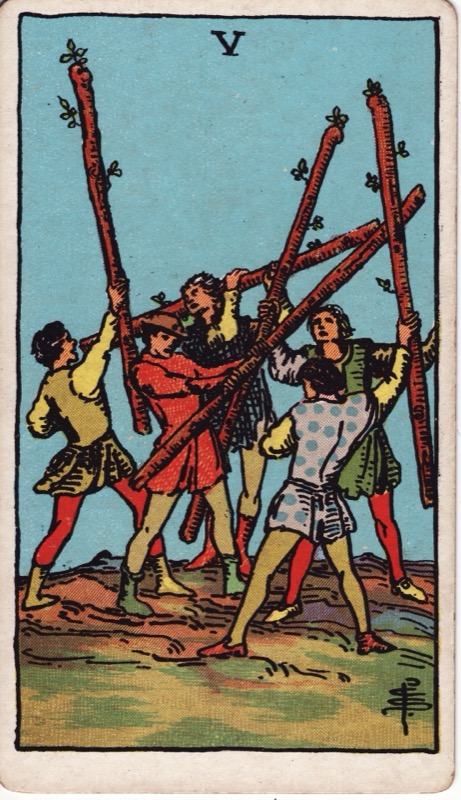
The Five of Wands shows five young men waving large wooden staves at one another in what looks like a brawl. Look closer at the Rider-Waite-Smith image and the fight loses its menace. Nobody has landed a blow. The staves clash in the air above their heads rather than against anyone’s body, and several of the men seem to be swinging at nothing in particular. The whole scene resembles a scuffle that broke out before anyone agreed on what they were fighting about.
Each man wears a differently colored and patterned tunic, which is the card’s central symbol. These are five separate agendas, five backgrounds, five opinions, and no shared uniform. The ground beneath them is bare and uneven, offering no established territory that any of them could claim as home advantage. The sky behind them is clear and pale blue, a quiet signal that whatever this conflict is, it is not a storm. Some readers see a mock battle or a training exercise in the scene, young men testing their strength against peers because that is how strength develops.
The number five marks the midpoint of every suit, where the stability of the four gets disrupted. In the fiery Suit of Wands, which governs ambition, energy, and will, that disruption takes the form of competing wills colliding. The Golden Dawn titled this card the Lord of Strife and assigned it Saturn in Leo, restrictive Saturn pressing against Leo’s need to shine, which captures the frustration of an ego that wants room and keeps bumping into four others.
Five of Wands Upright Meaning
The Five of Wands upright means competition, conflict, and clashing agendas. Several people want the same thing at once, or a group is pulling in five directions, and progress has stalled in the noise. The conflict is real but rarely destructive, and engaging with it directly usually improves your position.
The defining feature of this card is that the struggle is survivable. Nobody in the image is wounded, and nobody in your situation is likely to be either. What the card describes is the ordinary friction of people with strong opinions occupying the same space: the team where every meeting turns into a debate, the promotion that three colleagues are chasing, the family group chat that has been arguing about the same holiday plan for two weeks. The stakes feel high in the moment and look modest from six months away.
Upright, the card usually carries a challenge inside it. Competition tests whether you actually want the thing you say you want, and it tests it more honestly than an uncontested path ever could. If you pull this card while facing a rival, the reading is straightforward: you are expected to compete, and stepping into the contest openly will serve you better than pretending you are above it or quietly resenting it. Fire suits reward participation.
There is a second reading worth checking against your situation. Sometimes the five wands are all yours. Five projects, five commitments, five goals competing for the same limited energy, with the result that each one gets a fifth of your attention and none of them moves. If your life currently feels like the card looks, scattered swings with no target, the message is to pick one wand and put the others down for now.
The card also asks you to consider the quality of the conflict around you. Disagreement between people who all care about the outcome is a healthy sign, and teams that never argue are usually teams where somebody has stopped bothering. The Five of Wands only becomes a problem when the arguing replaces the work instead of improving it.
Five of Wands Upright: Love & Relationships
In love, the Five of Wands upright means competition, friction, or a relationship where the sparring has become the main event. The attraction is often genuine, but so is the conflict, and which one wins depends on how the arguing gets handled.
If you’re single, this card frequently means rivals. Someone you are interested in has other options and knows it, or you are dating in a crowded field where several people are pursuing the same person. The card does not tell you to withdraw. Wands energy favors showing up with confidence, making your interest plain, and letting the contrast work for you rather than sulking about the competition’s existence. It can also describe a dynamic of playful antagonism, the connection built on teasing and debate, which is fun early on and worth watching over time, because a spark that only ignites through friction can be hard to live with.
If you’re in a relationship, the Five of Wands points to a season of bickering. The arguments tend to be frequent and small rather than rare and serious: chores, money habits, whose family gets the holidays, the same three disputes on rotation. Underneath, there is usually a competitive current, two people keeping score instead of playing on the same team. The repair starts with noticing that pattern out loud. Couples who argue about the issue tend to recover; couples who argue to win tend not to.
Five of Wands Upright: Career & Work
In career readings, the Five of Wands upright means workplace competition and clashing opinions. You may be up against strong candidates for a role or promotion, or working inside a team where every decision triggers a debate and nothing ships on time.
If the competition is external, the card’s advice is to treat it as confirmation that the prize is worth having. Prepare thoroughly, put your case forward without apologizing for it, and resist the urge to campaign against your rivals instead of for yourself. Interviewers and managers notice the difference, and the second approach reads as strength while the first reads as insecurity.
If the conflict is internal, look at the structure before blaming the people. Teams descend into Five of Wands chaos when nobody has clear authority over the decision, so five capable people fill the vacuum with volume. Sometimes the most useful move is simply proposing a process: one owner per decision, a deadline for input, and a rule that a decision made stays made. The energy in this card is genuinely productive once it gets a channel.
Five of Wands Upright: Money & Finances
For money, the Five of Wands upright means financial friction and competing demands on the same funds. Every dollar has five possible destinations, and the household or business argument about priorities has been running for a while.
The card often shows up when partners disagree about spending, when several financial goals are being funded so thinly that none advances, or when you are bidding against others for something scarce, a house in a hot market being the classic case. In competitive purchases, know your ceiling before the contest starts, because auctions are engineered to make you forget it. In budget disputes, the fix mirrors the card’s core problem: too many priorities is the same as no priority. Rank the goals, fund the top one or two properly, and revisit the list quarterly instead of relitigating it weekly.
Five of Wands as Feelings
If you’re asking how someone feels about you, the Five of Wands means they feel a charged, competitive attraction with some friction mixed in. You provoke them, in both senses of the word. They find you stimulating and slightly maddening, and they have probably replayed a disagreement with you more than once.
This person may also see you as someone they have to compete for, and that perception is doing real work in their interest. Rivals, distance, or your own busy life have signaled that you won’t simply be available, and Wands energy responds to a challenge. The caution is that feelings built on contest can deflate once the contest ends, so watch whether their attention survives the moments when nothing is at stake. Interest that persists through the boring weeks is the kind worth taking seriously.
Five of Wands as Advice / Action
As advice, the Five of Wands tells you to enter the contest instead of avoiding it. Whatever you are competing for, the card says the competition itself is the current stage of the process, and there is no version of the path that routes around it.
Two refinements sharpen that advice. The first concerns targets: before you swing, be sure you know what you are actually fighting for, because half the figures on this card are swinging at air. A conflict without a defined win condition just burns energy. The second concerns tone. Compete hard on the merits and stay clean on the tactics, since the people you are sparring with today have a way of becoming colleagues, in-laws, and references later. If your situation is the scattered version of the card, the advice inverts into a single instruction: cut your active goals down until the number matches your actual capacity.
Five of Wands Reversed Meaning
The Five of Wands reversed means conflict that is ending, being avoided, or turning inward. It can signal genuine resolution after a tense period, a person who sidesteps every necessary confrontation, or a fight that has moved inside your own head. Context and surrounding cards decide which one applies.
The most welcome version is resolution. The dispute that dominated the last stretch, at work or at home, is losing steam. People are tired of fighting, common ground is appearing, and agreements that were impossible a month ago are suddenly available. If negotiations or a difficult conversation are on your calendar, the reversed Five of Wands is a favorable sign that the other side wants peace too.
The second version is avoidance, and it is the more common reading in practice. Here the conflict has not ended; it has gone underground. Someone is swallowing objections to keep the peace, agreeing in the meeting and complaining after it, or maintaining a surface calm over a resentment that grows in the dark. Suppressed conflict costs more than open conflict, because it never gets the chance to resolve. If you recognize yourself in this pattern, the card is naming the price of your silence.
The third version is inner conflict. The five wands become five of your own impulses at war: the job you have against the career you want, the person you love against the life you planned, discipline against appetite. Nothing external needs to change for this reading to fit, and the tell is exhaustion without any visible fight. Sorting out what you actually want, on paper if necessary, does more here than any conversation with anyone else.
Five of Wands Reversed: Love
In love, the Five of Wands reversed means either the fighting is finally stopping or the fighting has been driven underground, and the difference matters enormously.
If you’re single, the reversed card often means you have stepped back from a competitive situation, and usually wisely. Chasing someone who enjoyed being chased by several people was costing more than it returned, and the reversal marks your exit from that contest. It can also point to avoidance of the dating scene altogether after a bruising experience. A recovery period is healthy; just put a rough end date on it, because indefinite retreat quietly becomes a lifestyle.
If you’re in a relationship, the best version of this card is the end of a rough patch. The recurring argument has finally been talked through rather than merely paused, and both of you can feel the difference. The warning version is the couple that has stopped fighting because one of you has stopped engaging. Silence that follows resolution feels peaceful; silence that follows giving up feels flat, and you already know which one is in your house. If it is the second kind, raising the unspoken issue is uncomfortable and considerably safer than letting it calcify.
Five of Wands Reversed: Career & Money
For career and money, the Five of Wands reversed means workplace tension easing, or tension being suppressed in ways that will cost you later. A long-running office conflict may genuinely be resolving, with the difficult colleague transferred, the reorganization settled, or the turf war concluded. If so, use the calm to rebuild the working relationships that got strained.
The less comfortable reading is that you have gone quiet at work to avoid friction. You disagree with the direction of a project and say nothing, or you have stopped advocating for a raise you have earned because the negotiation feels like a fight. Avoidance here has a measurable salary attached to it. Financially, the reversed card can mark the end of money arguments at home, often because a plan finally got written down. It can also flag avoidance of the numbers themselves, the unopened statements and the budget conversation postponed for the fourth month. Look at the accounts this week, since the anxiety of knowing is smaller than the anxiety of not knowing.
Five of Wands Reversed as Feelings
If you’re asking how someone feels about you, the Five of Wands reversed means they are tired of the conflict between you and want it to end, or they are hiding their real feelings to avoid a confrontation. In the first case, an apology or truce may be closer than you think, and a small opening gesture from you could bring it forward. In the second, this person seems agreeable while privately holding objections or hurt they have decided not to voice. Their pleasantness is real but incomplete. Give them an easy, low-pressure way to say the uncomfortable thing, because they will not create that opening themselves.
Five of Wands: Yes or No?
The Five of Wands is a No. In yes-or-no readings it signals obstacles, competition, and disagreement standing between you and the outcome you asked about, so the smooth result you are hoping for is unlikely in the near term.
It is a soft no rather than a final one. The card describes contested territory, and contested territory can still be won with persistence and a clear head, so a better translation is “no for now, and only through effort.” If the card lands reversed, the answer improves slightly, since the resistance around your question is fading. For a direct answer on your own question, try a free yes or no tarot reading.
Five of Wands Card Combinations
The cards around the Five of Wands show what the conflict is about and how it resolves. These pairings appear often enough to memorize:
- Five of Wands + The Chariot: victory through sustained focus. The competition is real and you win it by wanting the outcome more consistently than your rivals do.
- Five of Wands + Two of Cups: rivalry in love. A genuine mutual connection with a third party or competitor in the picture, or two people whose spark runs through sparring.
- Five of Wands + Justice: a dispute settled formally and fairly. Legal proceedings, mediation, or an official ruling brings the fight to a clean end.
- Five of Wands + Ten of Wands: a conflict carried too long. The fight itself has become a burden, and putting it down matters more than winning it.
- Five of Wands + The Emperor: order imposed on chaos. Clear leadership, rules, or structure ends the squabbling; if nobody else supplies it, that authority role falls to you.
Five of Wands Meaning: Quick Reference
Use this table as the short version of the card during a reading.
| Context | Five of Wands means |
|---|---|
| Upright | Competition, conflict, rivalry, clashing agendas |
| Reversed | Conflict ending, avoidance, inner conflict |
| Love | Rivals or bickering; friction alongside real attraction |
| Career | Workplace competition; debate stalling progress |
| Yes or No | No (a soft no; effort can still change it) |
The Five of Wands sits between celebration and triumph in its suit. It follows the settled happiness of the Four of Wands, and the contest it depicts is what gets resolved in the public victory of the Six of Wands. Read in sequence, the message is encouraging: this stage of struggle is the middle of the story, and the next card shows how it ends.