Justice Tarot Card Meaning
Justice means fairness, truth, accountability, and the law of cause and effect. It is card 11 of the Major Arcana, and it appears when a situation is about to be weighed and decided on its actual merits. Upright, it promises an outcome that matches what you have earned, and it favors honesty, legal matters, and clear-eyed decisions. Reversed, it points to unfairness, dishonesty, avoided accountability, or a bias you haven’t admitted to yourself.
Justice Keywords
Justice’s core keywords are fairness and truth when upright, and unfairness and avoided accountability when reversed. The pairs below cover the card’s usual range in readings.
| Upright | Reversed |
|---|---|
| Fairness | Unfairness |
| Truth | Dishonesty |
| Cause and effect | Avoiding accountability |
| Accountability | Bias |
| Legal matters | Legal complications |
| Clear judgment | Self-deception |
| Balanced decisions | An unjust outcome |
| Integrity | Corruption |
Justice Description
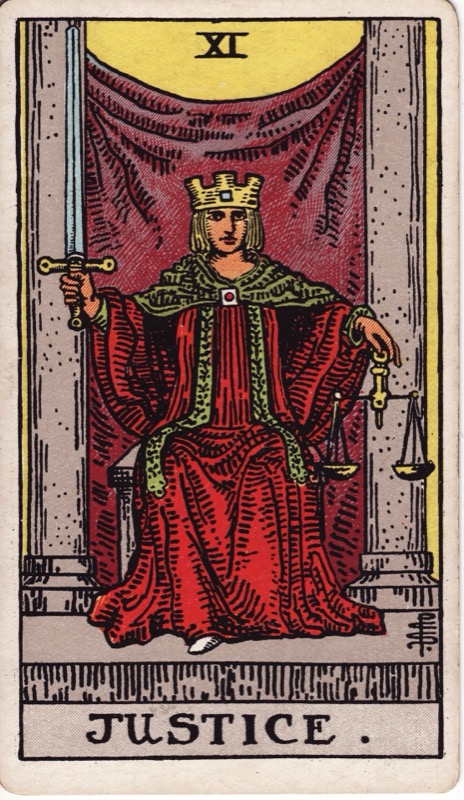
Justice shows a crowned figure seated on a stone bench between two grey pillars, holding a raised sword in the right hand and a set of scales in the left. In the Rider-Waite-Smith deck the figure looks directly out of the card at you, which is unusual in the Major Arcana and sets the tone immediately: this card examines the person asking the question.
Each object in the image does specific work. The upright double-edged sword stands for the clarity and the cost of truth, since a real verdict cuts both ways and someone always feels the edge. The scales weigh evidence rather than intention, which is why the card cares about what you did more than what you meant. The figure wears a red robe with a green mantle, and a small white shoe emerges from beneath the hem, usually read as a reminder that spiritual consequences follow from material actions. The crown carries a square jewel, a symbol of well-ordered thought. Behind the figure hangs a purple veil between the pillars, suggesting that the full workings of cause and effect stay hidden even while their results arrive on schedule.
Justice is numbered 11 and sits near the midpoint of the Major Arcana, the point where the story pauses to audit itself. Unlike The Emperor, who rules through authority, this figure rules through accuracy. The card corresponds to Libra and to the element of Air, the element of judgment and clear thought.
Justice Upright Meaning
Justice upright means the truth will come out and the outcome will be fair. It stands for accountability, honest dealing, legal matters resolving correctly, and decisions made with a clear head. If you have acted with integrity, this card says the result will reflect it.
The card operates on a simple mechanism: cause and effect. Whatever is being weighed in your reading, whether a court case, a workplace dispute, or a private question of conscience, Justice says the verdict will track the evidence. That is reassuring news for anyone who has been dealing straight and unsettling news for anyone who hasn’t, and the card makes no apology for either. Its only loyalty is to what actually happened.
Justice also appears when you are the one who must decide. Some choices need instinct, and this card describes the other kind, where the right answer emerges from laying out the facts, weighing them honestly, and accepting the conclusion even when it costs you something. Write the options down. Include the inconvenient facts, especially the ones you have been quietly excluding because they point away from the outcome you prefer. The scales in the image only work when everything goes on them.
There is a personal dimension too. Justice often asks you to take responsibility for your own share of a situation before assigning the rest. Most disputes have a distribution of fault rather than a villain, and readings where this card appears tend to go better for people willing to name their percentage. Accountability here isn’t punishment; it is the price of a clean resolution, and it is usually cheaper than the alternative of carrying the thing unresolved for another year.
Finally, the card is one of the deck’s strongest signals for formal and legal matters. Contracts, settlements, official decisions, and paperwork of every kind fall under it, and upright it says those processes will run the way they are supposed to run.
Justice Upright: Love & Relationships
In love, Justice upright means honesty and equal effort decide what happens next, and it favors relationships where both people carry a fair share of the weight.
If you’re single, this card often points to a partner met through balanced, adult circumstances rather than dramatic ones, and sometimes to someone connected to the legal or academic world. It also carries a karmic note: how you treated people in past relationships shapes what arrives now. If you ended things cleanly and honestly before, the card suggests that decency comes back to you. If your dating pattern involves avoidable dishonesty, Justice recommends fixing the pattern before expecting different results from it.
If you’re in a relationship, Justice asks whether the arrangement is actually fair. Who does the emotional labor, who compromises, who apologizes first, and whether the ledger between you has drifted badly out of balance. Couples rarely fight about the surface topic, and this card points at the imbalance underneath. It also governs the formal side of partnership, so it frequently appears around engagements, marriage, cohabitation agreements, and, when the relationship has already failed, a divorce that concludes on fair terms. Whatever the stage, the card’s instruction is the same: put the true numbers on the table and negotiate from there.
Justice Upright: Career & Work
In career readings, Justice upright means your work will be evaluated accurately, so results you have genuinely earned are on their way. Promotions, raises, and recognition that reflect real contribution all sit inside this card.
It appears often around workplace disputes, HR processes, and negotiations, and upright it says the process will land on the correct answer. If you have documentation, bring it, because this card rewards people who can show their work. If a colleague has been taking credit for yours, Justice suggests the discrepancy is about to become visible to the people who decide such things.
The card also favors careers in law, arbitration, compliance, auditing, and any field where being right matters more than being liked. If you have been weighing a move into that kind of work, Justice upright reads as an endorsement of the fit.
Justice Upright: Money & Finances
For money, Justice upright means financial matters resolve fairly and paperwork works in your favor. Settlements, tax decisions, insurance claims, loan approvals, and inheritance questions all tend to conclude correctly under this card.
It also asks for balance in your own accounts. Justice favors the boring virtues here: a budget that reflects reality, debts repaid on the agreed schedule, and financial honesty with a partner if money is shared. If you are owed money, the card supports pursuing it through proper channels rather than letting it slide. If you owe it, the card supports paying before the situation compounds, because the mechanism of cause and effect applies to interest as much as to anything else.
Justice as Feelings
If you’re asking how someone feels about you, Justice means they are weighing the relationship deliberately, with their head fully involved. Their feelings are real but measured, and they are quietly assessing whether what exists between you is fair, honest, and worth building on.
This is a person keeping score, in the neutral sense: they notice what they give and what they receive, and their long-term interest depends on those amounts roughly matching. It can feel less romantic than a rush of passion, and it tends to age better than one. Expect this person to value directness. Games and mixed signals read to them as evidence, and the evidence gets weighed. If you want to know where you stand, ask plainly, because Justice-flavored feelings respond well to plain questions and poorly to tests.
Justice as Advice / Action
As advice, Justice tells you to act with total honesty and let the consequences arrive. Tell the truth you have been softening, correct the record where you bent it, and make the decision by the facts rather than by what spares the most feelings, including your own.
The card adds a procedural note: handle the formal side properly. Get the agreement in writing, read the contract before signing, keep receipts, and follow the official process even when a shortcut looks harmless. Justice protects people who are on the record. It also asks you to hear the other side fully before judging, because the figure on the card weighs both pans of the scale, and any conclusion you reached without doing that is provisional whether you experience it that way or not.
Justice Reversed Meaning
Justice reversed means unfairness, dishonesty, avoided accountability, or a judgment distorted by bias. It can describe an outcome that genuinely wasn’t fair to you, a consequence you are dodging, or a story you keep telling in which you are more innocent than the facts support.
Which of those applies is the reading’s real question, and the honest answer usually arrives fast. Sometimes the card is validating: legal decisions do go wrong, credit does get taken, and people do lie their way out of consequences. When Justice reversed describes something done to you, it acknowledges the injury and adds that the ledger stays open longer than the verdict does. Correction may come through appeal, through time, or through the other party’s habits catching up with them, and your job meanwhile is to keep your own record clean enough that the eventual correction favors you.
More often, though, the reversed card puts the questioner on the scales. It appears when you are dodging a consequence you know you earned, delaying an apology, or hiding a mistake whose cover-up now costs more than the mistake did. It also covers subtler distortions, such as judging your own actions by intent while judging everyone else’s by impact, which is the most common bias this card describes. Under that accounting you will always be innocent and always be surrounded by offenders, and the reversed Justice card exists to point out that no honest scale produces that result.
The remedy in both versions is the same instrument: accurate weighing. If you were wronged, document it and pursue the correction through channels that work. If you did the wronging, the fastest route back to level ground is admitting it, because avoided accountability accrues interest and the rate is bad.
Justice Reversed: Love
In love, Justice reversed means unfairness or dishonesty is distorting the relationship, and something in the current arrangement would not survive being said out loud.
If you’re single, the card can point to unresolved bitterness from a previous relationship that has quietly become the standard by which you judge new people, which is unfair to them and expensive for you. It can also flag a prospect who isn’t being straight with you about their situation. If details in someone’s story fail to add up, Justice reversed says the discrepancy is information rather than coincidence.
If you’re in a relationship, this card often names a lopsided arrangement: one partner doing most of the work, most of the compromising, or most of the forgiving, while the other collects the surplus. It also covers active dishonesty, from financial secrets to infidelity, and double standards where one person is granted freedoms the other is denied. It can accompany a separation or divorce that is proceeding on unfair terms. The workable response starts with an accurate accounting of who contributes what, spoken without exaggeration on either side. A relationship that cannot survive that conversation was being held together by the silence.
Justice Reversed: Career & Money
For career and money, Justice reversed warns of unfair treatment, dishonest dealing, or paperwork problems, and it says the formal side of a situation deserves your suspicion right now. Read everything before signing, and get promises in writing, because verbal assurances are exactly what this card watches evaporate.
At work, it can mark a promotion given to the wrong person, credit misassigned, or a process that was rigged before it started. Document what happened while the details are fresh; reversed Justice situations often get a second hearing, and the person with records wins it. Be equally honest about the other possibility, which is that a setback you have filed under unfairness was actually feedback. One passed-over promotion can be politics, and a pattern of them is data.
Financially, the card flags disputes, delayed settlements, tax trouble, and deals where the other party’s numbers don’t withstand inspection. Slow down and verify before money moves.
Justice Reversed as Feelings
If you’re asking how someone feels about you, Justice reversed means their view of you is distorted, either by unfair judgment or by their own avoidance. They may be blaming you for more than your share of a problem, holding you to a standard they don’t apply to themselves, or dodging an honest conversation because it would obligate them to change something. Some people pulling this card find the reverse is true and they have been judging the other person on old evidence. Either way the connection is running on inaccurate books, and feelings built on inaccurate books shift when the books get corrected. A direct, non-accusatory airing of the facts will show you quickly whether this person can weigh them.
Justice: Yes or No?
Justice is a maybe, because the answer depends on the merits of your case. If you have acted honestly and your question rests on fair ground, read it as a yes. If getting your yes would require someone to overlook the facts, read it as a no.
This makes Justice one of the most conditional cards in yes-or-no work, and one of the most useful, since the condition tells you exactly what to fix. For legal and contractual questions specifically, upright Justice leans yes for the party in the right. Reversed, lean no, or expect delay and dispute before any resolution. You can test a question against a yes-or-no reading to see how Justice behaves alongside more decisive cards.
Justice Card Combinations
The cards around Justice tell you what is being weighed and how the verdict lands. These pairings are worth learning:
- Justice + The Emperor: formal authority rules in your matter. Contracts, official decisions, and institutional processes dominate the situation, and following procedure precisely is what wins.
- Justice + Judgement: a final, binding verdict. Together these two cards mark the definitive end of a long dispute, often with an element of public reckoning attached.
- Justice + Seven of Swords: deception meets consequences. Someone’s scheme is exposed and accounted for; if the scheme is yours, this pairing is the deck telling you the window for quiet correction is closing.
- Justice + Two of Cups: a fair and equal partnership, romantic or professional. This combination frequently accompanies engagements, marriages, and business partnerships built on genuinely balanced terms.
- Justice + Six of Pentacles: money reaches the right hands. Settlements, repayments, fair salaries, and honest generosity, with each party receiving what the record supports.
Justice Meaning: Quick Reference
Use this table as the short version of the card during a reading.
| Context | Justice means |
|---|---|
| Upright | Fairness, truth, accountability, cause and effect |
| Reversed | Unfairness, dishonesty, avoided accountability, bias |
| Love | Honesty and equal effort decide the outcome |
| Career | Accurate evaluation; disputes resolve on the merits |
| Yes or No | Maybe, yes if your cause is honest |
Justice weighs what the first half of the Major Arcana has done, and the next card asks you to hang in suspension while the verdict settles in. Continue to The Hanged Man, or browse all Major Arcana card meanings.