Three of Swords Tarot Card Meaning
The Three of Swords means heartbreak, grief, and a painful truth arriving all at once. It is card 3 of the Suit of Swords, and it usually appears when something has hurt you, or is about to, in a way that words made possible: a breakup, a betrayal, or news you did not want to hear. Upright, it names the pain honestly so you can grieve it. Reversed, it points to recovery, forgiveness, or grief that has been held in too long.
Three of Swords Keywords
The Three of Swords’ core keywords are heartbreak and painful truth when upright, and healing and the release of old pain when reversed. These pairs cover most of the ways the card shows up in a reading.
| Upright | Reversed |
|---|---|
| Heartbreak | Healing |
| Grief | Recovery |
| Sorrow | Forgiveness |
| Betrayal | Releasing pain |
| Painful truth | Suppressed grief |
| Separation | Reconciliation |
| Rejection | Optimism returning |
| Emotional wounds | Refusing to move on |
Three of Swords Description
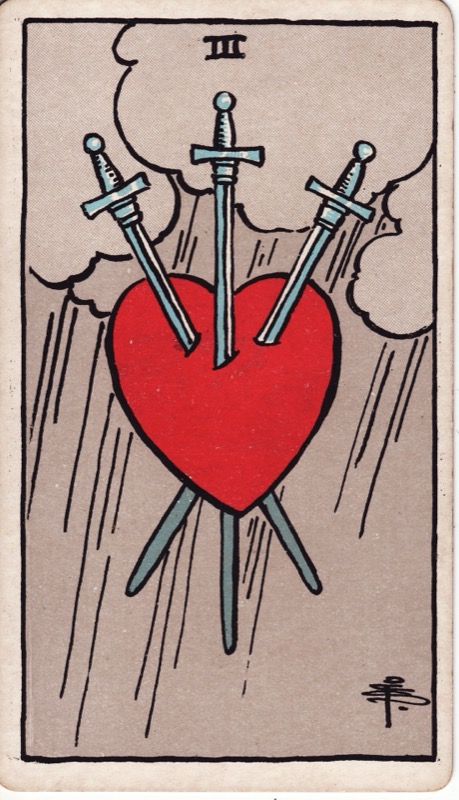
The Three of Swords shows a large red heart pierced by three swords against a gray sky, with storm clouds gathered behind it and rain falling in hard diagonal lines. It is one of the starkest images in the Rider-Waite-Smith deck. Most cards give you a scene with people in it; this one gives you a single symbol and no witnesses, which is close to how heartbreak actually feels from the inside.
Each element carries part of the meaning. The heart stands for the emotional life, and the swords stand for the suit’s element of air: thoughts, words, and facts. Three blades through one heart is the deck’s picture of what a sentence can do, whether that sentence is “I’m leaving,” “I lied to you,” or a diagnosis read aloud in an office. The rain reads two ways at once. It is the misery of the moment, and it is also the tears that eventually wash a wound clean, since crying is part of how grief completes itself. The clouds are heavy but they are weather, and weather passes.
Pamela Colman Smith drew the swords piercing the heart cleanly, without tearing it apart. The heart stays whole and intact around the blades, a quiet detail suggesting that the damage here is survivable. In the Golden Dawn tradition the card corresponds to Saturn in Libra and carries the title Lord of Sorrow, which fits: Saturn’s hard lessons landing in the sign of partnership.
Three of Swords Upright Meaning
The Three of Swords upright means heartbreak, grief, or a painful truth you can no longer avoid. It signals emotional pain caused by words or revelations, most often a breakup, a betrayal, or bad news, and it asks you to feel that pain fully rather than argue with it.
This is the card nobody wants to pull, so it helps to be precise about what it actually says. It says something hurts, or will hurt soon, at the level of the heart. It does not say the hurt is permanent, deserved, or the end of the story. Within the Suit of Swords, the threes mark the first real consequence of the suit’s energy: the Ace is the sharp new idea, the Two is the stalemate of not deciding, and the Three is the moment the truth lands. Whatever was suspended in the Two of Swords gets resolved here, painfully, by information.
In practice the card most often describes one of three situations. The first is loss: a relationship ending, a friendship breaking, a death or serious illness in your circle. The second is betrayal, where the pain comes from discovering what someone did or said. The third is a hard truth about yourself or your circumstances, the kind that stings precisely because it is accurate. In all three, the swords are made of words. What pierced the heart was said, written, or found out.
The card’s one piece of comfort is structural. Grief that is allowed to run its course ends. The rain in the image falls and then stops, and the people who recover fastest from this card’s events are usually the ones who let themselves hurt on schedule instead of postponing it. Cry, tell a friend the whole ugly version, take the weekend off from pretending you’re fine. The Three of Swords tends to appear near the sharpest point of the pain, which means a good portion of it is already behind you by the time you’re reading this.
Three of Swords Upright: Love & Relationships
In love, the Three of Swords upright means heartbreak: a breakup, a betrayal, a painful argument, or the discovery of something that changes how you see your partner. It is one of the clearest separation cards in the deck, so take it seriously in a relationship reading.
If you’re single, this card usually describes recent damage rather than incoming romance. You may be grieving an ex, smarting from a rejection, or carrying a hurt that colors every new date. The card’s advice is to finish the grieving before you restart the searching, because pain this fresh has a way of choosing your next partner for you, and it chooses badly. Occasionally it points to a current situation instead, such as involvement with someone unavailable, where the heartbreak is built into the arrangement and everyone quietly knows it.
If you’re in a relationship, the Three of Swords can mean a rupture is happening or surfacing: an affair, a devastating fight, or a truth one of you has been sitting on. It can also describe a third presence in the relationship, whether that is another person, an ex who never fully left, or an in-law whose words keep cutting. A rupture is not automatically an ending. Couples do survive this card, but only by handling the wound in the open. The relationships it actually finishes off are the ones where both people decide to pretend the swords aren’t there.
To see where this energy sits in your own situation, pull your cards in a free love reading.
Three of Swords Upright: Career & Work
In career readings, the Three of Swords upright points to a professional blow: a layoff, a rejection, harsh criticism, or a conflict with a colleague that turns personal. Something at work has hurt more than work is supposed to.
The most common versions are concrete. You were passed over for the promotion, the redundancy list had your name on it, the feedback in the review was brutal, or a coworker you trusted repeated something you said in confidence. The card acknowledges that these things wound real self-esteem, and it pushes back on the instinct to shrug them off as “just business” within the hour.
There is useful information inside the sting. Sword pain is made of words and facts, so once the first shock passes, look at what was actually said. Criticism delivered cruelly can still be partly accurate, and a rejection can reveal that you were pursuing the wrong role in the first place. Give yourself a few days of honest disappointment, then extract the lesson and leave the humiliation behind.
Three of Swords Upright: Money & Finances
For money, the Three of Swords upright means a financial loss or painful money news, often tied to a relationship: a costly breakup or divorce, a betrayal involving shared finances, or an expense triggered by a crisis.
The overlap with the emotional meaning is the point. This card’s money troubles usually have a person attached, whether that is a partner who hid debt, a friend who never repaid a loan, or a family dispute over an inheritance. Separate the two hurts if you can. The money problem has practical fixes, and dealing with it coldly, with documents and numbers, is often easier than dealing with the person. If you are facing a separation, get the financial facts on paper early, because clarity now prevents a second heartbreak later.
Three of Swords as Feelings
If you’re asking how someone feels about you, the Three of Swords means they feel hurt, and they associate at least some of that hurt with you or with the situation you share. They may be grieving the relationship, nursing a wound from something said, or feeling rejected and betrayed.
This does not always mean you caused the pain. The card can equally describe someone still bleeding from a previous relationship, whose guardedness with you is really scar tissue from someone else. Either way, the feeling underneath is sorrow rather than anger, and sorrow behaves differently: it withdraws, goes quiet, and protects itself. If this person has pulled back recently, the card suggests the distance is self-protection. A gentle, low-pressure conversation reaches someone in this state far better than demands for answers do.
Three of Swords as Advice / Action
As advice, the Three of Swords tells you to face the painful truth directly and let yourself grieve it. Whatever you have been avoiding knowing, or avoiding feeling, the card says the avoidance now costs more than the pain would.
That breaks into two possible actions depending on your position. If a hard truth needs to be spoken, speak it cleanly and soon, because dragging it out multiplies the swords. If a hard truth has already landed on you, your task is to metabolize it: talk to someone, write it down, let the tears in the card’s image do their work. The one thing this card advises against is anesthesia, meaning the rebound, the bottle, or the eighty-hour work week that postpones the grief without shrinking it. Pain processed now is smaller than pain stored for later.
Three of Swords Reversed Meaning
The Three of Swords reversed means healing after heartbreak, forgiveness, and the slow release of old pain. It can also mean the opposite process stalling: grief that has been suppressed, or a wound kept open long after it could have closed. Which one applies depends on what you’ve done with the pain so far.
The optimistic reading is the more common one. Reversed, the swords are loosening from the heart. The worst has already happened and is now receding: you are sleeping again, laughing at things again, and going hours at a time without thinking about it. Forgiveness often belongs to this stage, whether that means forgiving the person who hurt you or forgiving yourself for the part you played. In relationship readings the reversal can even point to reconciliation, an apology arriving, or a rift beginning to mend, provided both people are honest about what caused it.
The second reading applies when the healing never started. Some people respond to a Three of Swords event by refusing to feel it, and the reversal then describes grief pushed underground: the breakup you claim you’re over but cannot discuss calmly, the loss you never let yourself cry about. Buried grief doesn’t decay, it waits, and it tends to leak out sideways as irritability, numbness, or cynicism about anything hopeful. A related version is the person who does the opposite and will not put the grief down, retelling the story of the wound for years until it becomes an identity.
To tell which reading is yours, check the direction of movement. If the pain is smaller this month than last month, you’re healing and the card is confirming it. If it is identical to what it was a year ago, something in you has hit pause, and the card is asking you to press play, on your own or with a professional.
Three of Swords Reversed: Love
In love, the Three of Swords reversed means recovery from heartbreak, and sometimes reconciliation. The acute phase is over; what happens next depends on whether you let the wound finish closing.
If you’re single, this is a genuinely encouraging pull. It suggests you are coming out the far side of a painful chapter and your capacity for connection is returning. The one warning attached is about timing and honesty: check that you have actually processed the last relationship rather than redecorated over it. Dating while secretly hoping to be rescued from grief puts a weight on new partners that most of them can feel within three dates.
If you’re in a relationship, the reversal often shows a couple healing after a serious breach, such as rebuilding trust after an affair or repairing things after a fight that went too far. That repair is real and worth crediting. It can also show the failure mode: a couple who declared the crisis “behind us” without ever discussing it, and who now live carefully around an unexploded topic. Forgiveness that skips the conversation is usually just silence wearing forgiveness’s clothes. If a subject in your relationship has become unmentionable, the card is pointing straight at it.
Three of Swords Reversed: Career & Money
For career and money, the Three of Swords reversed means recovering from a professional or financial blow: getting back on your feet after a layoff, rebuilding confidence after harsh criticism, or paying down the damage from an expensive crisis.
The practical guidance is about pace and residue. Recovery is underway, so support it with steady, boring moves: update the CV, rebuild the emergency fund, take the interviews even if the last rejection still stings. Watch for residue from the original wound, because a bad layoff can leave someone too gun-shy to negotiate salary, and a betrayal by a business partner can harden into refusing all collaboration. Caution earned from experience is wisdom right up until it starts costing you opportunities, and this card marks the point where it might be.
Financially, the reversal favors settling old wounds on paper: close out the shared accounts from the divorce, formalize the repayment plan, stop letting an unresolved money conflict tick along in the background.
Three of Swords Reversed as Feelings
If you’re asking how someone feels about you, the Three of Swords reversed means they are getting over a hurt, and their feelings toward you are thawing as the pain recedes. If you two had a rupture, they are closer to forgiving it than their behavior may show, since people often act guarded longest right before they stop needing to.
The alternative is someone who has decided not to heal, who still holds the old wound between you like evidence. You can usually tell the difference within a few conversations: the first person softens when you’re kind to them, the second person treats kindness as suspicious. With the first, patience pays off. With the second, no amount of patience substitutes for the work they haven’t done.
Three of Swords: Yes or No?
The Three of Swords is a no. In yes-or-no readings it is one of the deck’s clearest negative cards, and it typically means the path you’re asking about leads through disappointment or heartbreak. For questions like “will we get back together” or “should I trust this person,” treat the answer as no unless the surrounding cards strongly argue otherwise.
Reversed, it softens to a qualified no or a slow-turning maybe: the situation is improving, but it is not a green light yet. Pain this card describes tends to fade on its own schedule, so if the answer matters, ask again once things have settled rather than pushing for a yes today.
Three of Swords Card Combinations
The cards around the Three of Swords tell you what kind of heartbreak it is and where it leads. These pairings come up often:
- Three of Swords + The Lovers: heartbreak inside a major relationship choice. Often a love triangle, or a painful decision between two people or between love and another path.
- Three of Swords + Seven of Swords: betrayal through deception. An affair, a secret, or a lie coming to light is the source of the pain.
- Three of Swords + Ten of Swords: the heartbreak runs to a full, final ending. Painful to see, but it removes the false hope of a partial fix and clears the ground completely.
- Three of Swords + The Star: grief followed by genuine healing. The wound is real, and so is the recovery; this is one of the most hopeful contexts the card can appear in.
- Three of Swords + Two of Cups: a rupture in a close, loving partnership, or a reconciliation after one. Spread position and the question decide which way it reads.
Three of Swords Meaning: Quick Reference
Use this table as the short version of the card during a reading.
| Context | Three of Swords means |
|---|---|
| Upright | Heartbreak, grief, betrayal, a painful truth |
| Reversed | Healing, forgiveness, releasing pain, or suppressed grief |
| Love | Breakup, betrayal, or a wounding conflict; honesty decides what survives |
| Career | A professional blow: layoff, rejection, harsh criticism |
| Yes or No | No |
The Three of Swords delivers the wound, and the next card in the suit prescribes the rest that follows it. Continue to the Four of Swords, or step back to the Two of Swords to see the stalemate that preceded it.