Ten of Swords Tarot Card Meaning
The Ten of Swords means a painful ending, betrayal, defeat, and rock bottom. It is card 10 of the Suit of Swords, the final and heaviest card in a suit that tracks the mind’s hardest terrain. Upright, it confirms that something has ended badly and completely, and that the only direction left is forward. Reversed, it points to slow recovery, or to a collapse you keep postponing by refusing to let a dying situation die.
Ten of Swords Keywords
The Ten of Swords’ core keywords are painful endings and betrayal when upright, and recovery and resisting an inevitable end when reversed. The pairs below cover most of the ways the card behaves in a real spread.
| Upright | Reversed |
|---|---|
| Painful ending | Recovery |
| Betrayal | Slow healing |
| Rock bottom | Resisting an inevitable end |
| Defeat | Old wounds resurfacing |
| Crisis | Survival |
| Loss | Fear of ruin |
| Exhaustion | Regeneration |
| Finality | Lessons finally learned |
Ten of Swords Description
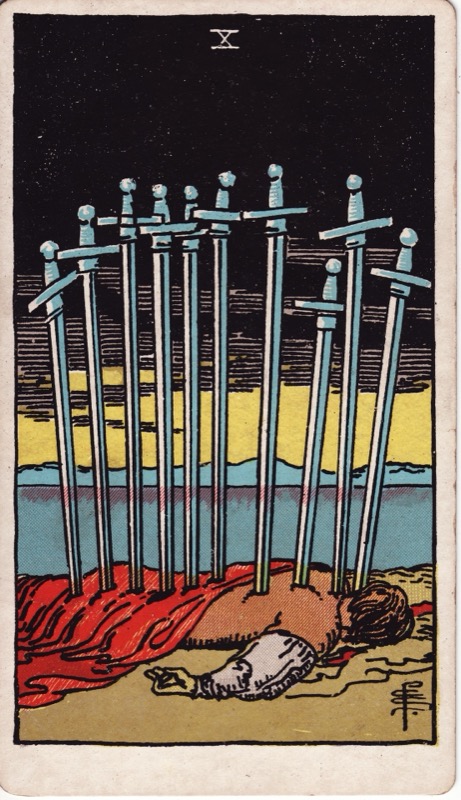
The Ten of Swords shows a man lying face down on the ground with ten swords planted in his back. The Rider-Waite-Smith artwork does not soften the scene, and it isn’t meant to; this is the deck’s most theatrical image of defeat. One sword would have been enough, so the other nine tell you something about excess. Whatever happened here went far beyond what the situation required, which is why the card so often describes betrayal or a loss that felt gratuitously cruel.
The details around the body change the reading. The sky above him is solid black, but along the horizon a band of gold light is rising over a calm sea. Dawn is already underway while the worst moment is still on screen. A red cloak drapes across the lower half of his body, a small gesture of dignity in an undignified scene. Look at his right hand: the fingers are arranged in the same sign of blessing that the Hierophant makes, a quiet hint that even this ending carries something worth keeping.
The number ten marks the completion of a cycle in the Minor Arcana. In Cups and Pentacles that completion is happy. In Swords, a suit concerned with conflict, anxiety, and hard truths, completion means the mental struggle has run its full course and exhausted itself. Nothing in this storyline continues past this card. The next card in the suit, the Page, starts an entirely new one.
Ten of Swords Upright Meaning
The Ten of Swords upright means a painful ending has arrived, often through betrayal or a sudden collapse, and the situation cannot be revived. It marks rock bottom, and because it is the final card of its cycle, it also marks the point where things stop getting worse.
The most useful thing to know about this card is its finality. Plenty of tarot cards describe trouble that might still be salvaged. This one does not. The relationship, the job, the plan, or the version of events you were holding onto has finished, and the card’s advice begins from that fact rather than arguing with it. People who pull the Ten of Swords usually already know what it refers to. The card’s role is confirmation, and confirmation has real value when you have spent weeks talking yourself out of what you can plainly see.
Betrayal sits near the center of the upright meaning. Ten swords in the back is the deck’s image for being blindsided by someone trusted, and in practice the card often turns up around infidelity, a colleague taking credit or spreading damage, a friend’s disloyalty, or a partner’s exit that came without warning. If no third party is involved, the card can describe self-sabotage instead, the pattern where your own anxious thinking (this is Swords, after all) finally drove a situation into the ground.
There is a second layer, and it matters as much as the first. The dawn on the horizon is part of the picture, and readers who ignore it read only half the card. Rock bottom is a location with one exit. Once the ending is complete, the dread of it ends too, and many people report a strange relief when this card’s event actually lands, because the long anticipation was worse than the fact. The Ten of Swords also has a reputation for melodrama. Ten swords for one wound suggests the story you are telling about the event may be somewhat larger than the event. Grieve the real loss fully, and check whether you have added a few swords of your own.
Ten of Swords Upright: Love & Relationships
In love, the Ten of Swords upright means a relationship has ended or is ending painfully, and it frequently signals betrayal, most often infidelity or a partner who left without honest warning.
If you’re single, this card usually describes the wound you are still carrying rather than anything on the horizon. A past betrayal is running your current dating life, whether that shows up as avoiding people entirely or testing new partners for crimes they haven’t committed. The card asks you to name the old injury accurately so it stops choosing for you. It can also confirm that a situationship you keep reviving is genuinely over, and that reviving it again would mean lying down among the swords voluntarily.
If you’re in a relationship, the Ten of Swords is one of the hardest cards to receive. It can indicate infidelity, a deep breach of trust, or a partnership that has already died in every way except the paperwork. If you have been waiting for a sign about whether to keep fighting for it, this card answers plainly. What it cannot tell you is whether the ending is the relationship itself or a phase of it; occasionally the card marks the death of an old dynamic between two people who then rebuild something honest. That reading only applies when both partners can look directly at what happened. If one of you is still minimizing it, take the card at face value.
Ten of Swords Upright: Career & Work
In career readings, the Ten of Swords upright points to a job loss, a failed project, a layoff, or workplace betrayal such as a colleague undermining you or taking credit for your work. The professional chapter it refers to is over.
Redundancy and abrupt dismissal are this card’s most literal workplace meanings, and it also covers the slower version where a role has become so draining that continuing amounts to self-harm by calendar. Burnout at the level this card describes does not respond to a long weekend.
If a betrayal at work is the theme, the card counsels documentation and exit over revenge. Office knife-fights reward the person with the least to lose, and that person is rarely you. The more constructive reading is the cycle one: the Ten closes a professional storyline so a new one can start, and people routinely look back on the layoff described by this card as the shove they needed toward better work. That reframe is only available after you stop trying to resurrect the old role.
Ten of Swords Upright: Money & Finances
For money, the Ten of Swords upright means a financial low point: a loss that has already happened, a venture that failed, or debt reaching the level where it can no longer be ignored. The card marks the bottom of the cycle rather than a further fall.
Its practical instruction is a full and honest accounting. Rock bottom has one advantage, which is that the numbers finally get looked at. Total the debt, name the loss, and stop paying to keep a failed investment on life support; money sent after a sunk cost is a new loss, and the card counts it as another sword. If someone else caused the damage, through fraud or a partner’s hidden spending, get objective eyes on the accounts before rebuilding. Recovery plans built on the numbers as they are tend to hold.
Ten of Swords as Feelings
If you’re asking how someone feels about you, the Ten of Swords means they feel hurt, defeated, and done. They experience the situation between you as an ending, and often as a betrayal, whether or not you intended one.
This person is likely exhausted rather than angry; the fight has gone out of them, and what remains is a flat sense that the connection cost more than it gave. If you are asking about an ex, the card suggests they see the breakup as final and are somewhere in the process of accepting that. Be careful with one nuance: Swords cards describe mental states, and mental states can be more dramatic than the facts. The feeling of total devastation this card reports is real to the person feeling it, even when an outside observer would call the situation survivable. Take the depth of hurt seriously without assuming it is permanent.
Ten of Swords as Advice / Action
As advice, the Ten of Swords tells you to accept the ending and stop trying to resuscitate what has died. Continued effort at this stage costs you energy the recovery will need, and every day spent renegotiating a finished situation delays the dawn the card promises.
Acceptance here is an action with concrete steps: send the message that closes the loop, sign the papers, file the claim, or finally say the words out loud to someone. The card also advises an honest audit of your own contribution, since a few of the ten swords usually turn out to be self-inflicted, and knowing which ones prevents a repeat performance. Rest belongs in the plan too. The figure on the card is lying down, and after a collapse of this size, lying down for a while is a legitimate strategy rather than a failure.
Ten of Swords Reversed Meaning
The Ten of Swords reversed means recovery from a painful ending, old wounds resurfacing, or resistance to a collapse that is coming regardless. You are either getting up from rock bottom or refusing to admit you are lying on it.
The recovery reading is the more common one. Reversed, the swords are loosening, and the card describes the early, unglamorous phase of getting back up: sleeping properly again, telling the story of what happened without shaking, making the first small plans that assume a future. Healing at this stage is fragile and genuine at the same time. The card asks you to protect it by not returning to the source of the wound for one more round, which is the single most common way this recovery gets undone.
The second reading is resistance. Reversed, the Ten of Swords can describe someone holding a dead situation upright through sheer effort, whether that is a relationship, a business, or a story about themselves that stopped being true a while ago. The ending is not in question, only its date, and every month of postponement adds interest to the final bill. If you recognize yourself here, the card’s message is that controlled endings hurt less than collapses, and you still have time to choose the controlled one.
A third, less frequent reading is the resurfacing of an old wound: a betrayal you thought was fully processed sends up new pain, often triggered by a fresh situation that rhymes with it. This is normal and does not mean the earlier healing failed. Sorting out which of the three readings applies is straightforward in context, because one of them will describe your month and the others will not.
Ten of Swords Reversed: Love
In love, the Ten of Swords reversed means you are healing from heartbreak or betrayal, or clinging to a relationship that has already ended in everything but name. The card asks which of those two you are actually doing, since they can look similar from the inside.
If you’re single, the hopeful reading is strong here. The reversed Ten often marks the point where an old betrayal finally loses its grip, and interest in new people returns on its own instead of being forced. Let that happen at its own pace. The warning reading is the ex who reappears just as you recover; going back to the person holding the swords is the specific mistake this card exists to flag.
If you’re in a relationship, the reversed card can go two ways. It may show a couple genuinely recovering from a serious breach, doing the slow trust-rebuilding that follows a crisis, and in that case it is quietly encouraging. It may instead show one or both partners refusing to accept that the relationship is over, staying for the sunk cost or the fear of starting again. The test is direction: if things have been measurably improving for months, you are healing. If you are only rereading old messages and waiting, you are resisting.
Ten of Swords Reversed: Career & Money
For career and money, the Ten of Swords reversed means recovery after a professional or financial low, or a refusal to close down something that is failing. Rebuilding is the dominant note: finding work after a layoff, restoring savings after a loss, or regaining confidence after a public defeat.
The recovery it describes is incremental, so measure progress in months. If the resistance reading fits instead, the card points at the business kept alive past its viability, the debt strategy of not opening the envelopes, or the job you have mentally quit but physically still attend. Set an end date and honor it. Financially, the reversed Ten also cautions against desperation moves during early recovery, because get-well-quick schemes recruit precisely the people this card has just described. Rebuild at the boring pace that works.
Ten of Swords Reversed as Feelings
If you’re asking how someone feels about you, the Ten of Swords reversed means they are slowly healing from hurt connected to you, or they cannot let go of pain the relationship caused. In the first case, their feelings are cautiously softening, and pressure from you will slow that process rather than speed it. In the second, they are still replaying the ending and may cast you as the villain of it, accurately or otherwise. Either way, this person is mid-recovery rather than finished, and the respectful move is to give the wound the time it is asking for. If reconciliation is possible at all, it happens after this stage, and it can’t be negotiated during it.
Ten of Swords: Yes or No?
The Ten of Swords is a no. In yes-or-no readings it is one of the clearest negative cards in the deck, and it specifically warns that pursuing the question’s goal leads to a painful ending or has already failed. Questions about reviving a relationship or rescuing a struggling venture receive an especially firm no from this card.
The one consolation is built into the artwork: the dawn behind the figure means the no closes this door rather than all doors. If the card lands reversed, the no softens slightly toward recovery and moving on, but it never turns into a yes. To put your own question to the cards, try a free yes or no tarot reading.
Ten of Swords Card Combinations
The cards around the Ten of Swords tell you what ended and what follows it. These pairings are worth knowing:
- Ten of Swords + The Sun: the dawn on the horizon made explicit. A hard ending gives way to a genuinely bright new period, and the recovery will be faster than you expect.
- Ten of Swords + Six of Swords: departure after defeat. This pair says the healing requires physically leaving, whether that means a move, a resignation, or blocked contact.
- Ten of Swords + The Devil: a destructive attachment reaching its painful conclusion, or a warning that you keep returning to the situation that wounds you. Addiction-shaped patterns belong to this pairing.
- Ten of Swords + Ace of Wands: collapse followed by a spark. The ending clears space for a new project or passion, and the new thing arrives sooner after the old one is fully released.
- Ten of Swords + Judgement: an ending that doubles as a rebirth. Together these cards frame the loss as the close of an entire life chapter, with an accounting to do before the next one opens.
Ten of Swords Meaning: Quick Reference
Use this table as the short version of the card during a reading.
| Context | Ten of Swords means |
|---|---|
| Upright | Painful ending, betrayal, rock bottom, the completion of a hard cycle |
| Reversed | Recovery, old wounds resurfacing, resisting an inevitable end |
| Love | Breakup or betrayal; healing when reversed |
| Career | Job loss, failed project, or workplace betrayal; the chapter is over |
| Yes or No | No |
The Ten of Swords closes the suit’s long storyline of struggle, and the card after it starts fresh with new curiosity. Continue to the Page of Swords, or go back to the Nine of Swords.