Judgement Tarot Card Meaning
Judgement means awakening, rebirth, and a call you can no longer ignore. It is card 20 of the Major Arcana, the second-to-last card in the sequence, and it appears when a period of your life is asking to be evaluated honestly and then closed. Upright, it signals a moment of reckoning that frees you to move into something larger. Reversed, it points to self-doubt, harsh inner criticism, or a call you keep pretending you haven’t heard.
Judgement Keywords
Judgement’s core keywords are awakening and rebirth when upright, and self-doubt and avoidance of the call when reversed. The table below covers the meanings this card carries most often in real readings.
| Upright | Reversed |
|---|---|
| Awakening | Self-doubt |
| Rebirth | Harsh self-judgment |
| Inner calling | Ignoring the call |
| Reckoning | Refusing to learn from the past |
| Absolution | Guilt that won’t resolve |
| Second chances | Stagnation |
| Honest self-evaluation | Fear of change |
| Closure | A verdict delayed |
Judgement Description
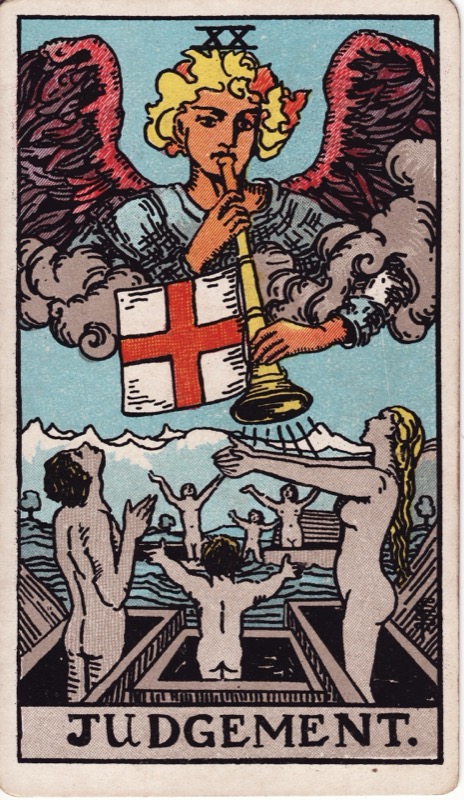
Judgement shows the archangel Gabriel filling the top half of the card, emerging from a bank of clouds and blowing a golden trumpet. A white flag with a red cross hangs from the trumpet. Below him, gray-skinned figures rise from open coffins that float on a wide sea, their arms lifted toward the sound. In the foreground stand a man, a woman, and a child; more figures answer the call in the distance behind them.
The scene is the Christian Last Judgment, and the Rider-Waite-Smith deck uses it for a specific reason. The people in the image are not being condemned. They are being woken up. Their gray skin marks the deadened state they have been living in, and the trumpet reaches them anyway, across water and through the lids of their own coffins. Whatever they were before this moment, the call still comes for them, which is why absolution and second chances sit at the center of this card’s meaning.
The icy mountains on the horizon are usually read as the abstract, unchangeable backdrop of truth: the standard against which the reckoning happens. The sea beneath the coffins connects the card to the subconscious, the place the call rises from when it feels like it arrives out of nowhere. Numbered 20, Judgement is the deck’s final threshold. After the reckoning it depicts, only The World remains.
Judgement Upright Meaning
Judgement upright means an awakening has arrived and a period of your life is ready to be judged, absorbed, and closed. It stands for honest self-evaluation, rebirth, and a calling toward a larger purpose. Answer the call, because it will keep sounding until you do.
This card marks the moment when scattered experience suddenly organizes itself into a verdict. You look back at the last job, the last relationship, or the last several years, and you can finally see what it all added up to and what it was trying to teach you. That clarity usually arrives with a strong sense of what comes next. People describe it as a wake-up call, a moment of truth, or the point where they stopped being able to lie to themselves about what they wanted.
The reckoning part of Judgement deserves to be taken literally. The card asks you to review your own record without flinching: the choices that worked, the ones that didn’t, and the patterns you repeated longer than you should have. This review has a purpose beyond discomfort. Judgement offers absolution on the other side of honesty. Once you have named what happened and taken your share of the responsibility, the debt is considered paid, and dragging the guilt any further serves nobody.
Judgement also carries the idea of a calling in the vocational sense. If a pull toward a specific kind of work, service, or life change has been getting louder, this card confirms the pull is real and worth reorganizing around. The trumpet in the image is loud on purpose. Callings of this kind rarely whisper once, then vanish; they repeat until answered, and each repetition costs you something in restlessness.
Practical decisions often ride along with this card. Legal matters, formal evaluations, results, and verdicts of every kind fall under Judgement, and upright it generally favors a fair outcome, especially for anyone who has acted in good faith. Where you have a choice about timing, the card supports resolving open questions now instead of letting them run another year.
Judgement Upright: Love & Relationships
In love, Judgement upright means a relationship is reaching a moment of truth, and the honest verdict will renew it or release you from it. Either outcome counts as the card working correctly.
If you’re single, Judgement often points to the end of a long recovery period. You have processed the past thoroughly enough that it no longer runs your dating decisions, and a connection with real weight can now get through. This card is also one of the classic signals of a person from your past resurfacing. If an old flame reappears under Judgement, the question the card asks is whether both of you have genuinely changed. When the answer is yes, few cards support a reunion more strongly.
If you’re in a relationship, Judgement calls for a candid joint review. Long-avoided topics, the state of the physical relationship, resentments filed away for the sake of peace, all of it belongs on the table. Couples who do this work under Judgement tend to come out the other side feeling like the relationship has been reborn, because in a real sense it has. Couples who discover the honest verdict is that it’s over are also getting what the card promises, which is release rather than another year of slow drift.
Judgement Upright: Career & Work
In career readings, Judgement upright means an evaluation is coming and a truer vocation is calling, so treat this as the moment to align your work with what you actually want to do. Performance reviews, interviews, audits, and applications all tend to resolve fairly under this card.
Judgement appears constantly for people who have outgrown a role. The job that once fit has quietly become a coffin lid, and the card announces that the lid is open. Career changes made under Judgement have a distinctive quality: they feel less like ambition and more like answering something. Teaching, medicine, counseling, advocacy, and creative work all show up frequently, though the calling can just as easily be a different company culture or the decision to work for yourself.
If a specific verdict is pending, such as a promotion decision or the outcome of a restructure, the upright card leans favorable, with the caveat that Judgement rewards a clean record. Where your own performance has been the problem, the card expects you to own that in the review rather than argue with it.
Judgement Upright: Money & Finances
For money, Judgement upright means a financial reckoning that ultimately works in your favor. It covers debts finally cleared, settlements resolving, insurance and tax decisions landing, and the moment you sit down and face the numbers you have been avoiding.
The card’s advice is to run the full audit. Pull the statements and total the debts, because Judgement’s absolution only follows honesty, and vague dread cannot be budgeted for. Many people find the true number is less frightening than the vague dread was, and a workable plan appears within a day of looking. Money tied to the past is also highlighted here: an inheritance, an old pension, a deposit you forgot, or repayment of a loan you had written off. Where a legal or formal financial decision is pending, upright Judgement points toward a fair result.
Judgement as Feelings
If you’re asking how someone feels about you, Judgement means they are re-evaluating everything, and you sit at the center of the review. This person has been looking back over what happened between you, weighing their own part in it, and arriving at conclusions that feel final to them.
For an ex or an estranged connection, this is one of the strongest cards for a change of heart. It frequently precedes the message that begins with an apology or the words “I’ve been thinking.” For a newer connection, Judgement suggests they feel the relationship is a turning point, something serious enough to make them reassess what they want from their life generally. What the card asks of you is patience with the process. A verdict reached under Judgement tends to be lasting, so a few weeks of their deliberation is a reasonable price for it.
Judgement as Advice / Action
As advice, Judgement tells you to face the review and answer the call. Whatever you have been postponing evaluation of, whether a relationship, a career, or your own conduct in a specific situation, the useful action is to judge it honestly this week and act on the verdict.
The card sets one clear standard for how to do this: the tone of a fair judge rather than a prosecutor. You are looking for the truth of what happened and the lesson inside it, and once both are named, the sentence is served. Endless re-litigation of your own past counts as avoidance in this card’s terms, because a person still arguing the old case never has to start the new one. When the verdict is in, close the file and let the people affected know, so that your full attention can go to whatever the trumpet is calling you toward.
Judgement Reversed Meaning
Judgement reversed means self-doubt, harsh inner criticism, or a life-changing call you keep refusing to answer. It describes a person who has heard the trumpet clearly and stayed in the coffin, or one whose inner judge has become so punishing that no verdict is ever final.
The reversal distorts the upright card in a few recognizable ways. The most common is the ignored calling. You know what the change is. You have known for months, possibly years, and you have built a sophisticated case for why now is a bad time. Reversed Judgement names the cost of that case: the call does not expire, and the energy spent suppressing it comes out of the same account that would have funded answering it. People under this card often report a flat, muffled quality to daily life, which is exactly how the gray figures in the image lived before the trumpet sounded.
The second pattern is the merciless inner critic. Instead of one honest review followed by absolution, the reversed card describes a trial that never ends. Old mistakes get replayed on a loop, apologies already accepted get re-examined, and the standard applied to your own past is one you would never apply to a friend’s. This version of the card blocks growth just as effectively as avoidance does, since a person serving a permanent sentence sees no point in building anything new.
A third, outward-facing version involves judging others too quickly or being judged unfairly yourself: gossip, a biased evaluation, or a decision made about you without your side being heard. Where a formal verdict is pending, the reversed card can indicate a delay or an outcome that requires an appeal. In every variation, the correction is the same. Hold one fair, complete review, accept its findings, and let the case close.
Judgement Reversed: Love
In love, Judgement reversed means the past is being handled badly, through avoidance, endless self-blame, or a verdict on the relationship that keeps getting postponed.
If you’re single, the most frequent reading is unfinished business blocking new connections. This can look like comparing every date to an ex, or like carrying so much blame for a previous relationship’s failure that you disqualify yourself before anything starts. The reversed card also cautions against reunions taken purely out of nostalgia. An old flame returning under this card has usually changed less than they claim, and the review you skipped the first time still needs to happen before round two.
If you’re in a relationship, reversed Judgement points to a couple avoiding the conversation that would settle things. Both people can feel the relationship is at a decision point, and both keep steering around it, one from fear of the answer and the other from fear of the conflict. Score-keeping is the other signature: old offenses reintroduced in every argument, forgiveness announced and then revoked. The card’s request is a single honest reckoning, held once, with the results actually honored afterward. To see where your own situation stands, try a free love tarot reading.
Judgement Reversed: Career & Money
For career and money, Judgement reversed warns of an unfair or stalled verdict, or of your own refusal to act on an assessment you already trust. The review that keeps getting rescheduled, the promotion decision stuck in limbo, and the feedback you received and then filed away unread all belong to this card.
If you were passed over or evaluated by someone with incomplete information, the reversed card supports asking for specifics and appealing through proper channels rather than swallowing the result. If the honest assessment is your own and it says the career no longer fits, the card observes that you have now known this for a while. Delaying the decision has become the decision.
Financially, reversed Judgement flags avoidance of the numbers: unopened statements, an unfiled return, a debt strategy that consists of not thinking about the debt. Interest and penalties compound during exactly this kind of silence, so the cheapest day to look is today.
Judgement Reversed as Feelings
If you’re asking how someone feels about you, Judgement reversed means they are stuck in their own unresolved past and cannot reach a verdict about you. Some are consumed by guilt over how they treated you or someone before you, and the guilt reads as distance. Others are judging you against an old story, a previous partner or an old version of you, rather than seeing who is actually in front of them. The feeling underneath is usually warmer than the behavior suggests, but a person mid-trial has little to offer, and the card cautions against volunteering to wait indefinitely while they deliberate.
Judgement: Yes or No?
Judgement is a yes, particularly for questions about second chances, reconciliation, formal decisions, and life changes you already feel called toward. As one of the deck’s cards of rebirth, its overall orientation is toward a positive resolution.
The yes comes with a condition attached: honest accounting. Outcomes under Judgement go well for people who have faced their situation squarely, so if part of the picture is still being avoided, resolve that first. Reversed, read the answer as a delayed or conditional yes, one that arrives after the avoidance ends.
Judgement Card Combinations
The cards around Judgement tell you what is being judged and what the rebirth leads into. These pairings appear often:
- Judgement + The World: the deck’s clearest completion signal. A major life chapter closes fully and successfully; graduations, final decrees, and long projects ending well all fit here.
- Judgement + The Devil: a wake-up call about an addiction, obsession, or toxic attachment. The awareness needed to break the chain has arrived, and the pairing favors acting on it immediately.
- Judgement + Justice: legal and formal matters front and center. Contracts, court outcomes, and official rulings resolve, generally in line with what fairness would predict.
- Judgement + Six of Cups: the past returning in person. An old friend, an ex, or a hometown connection resurfaces, and the pairing asks whether the reunion serves who you are now.
- Judgement + Two of Cups: reconciliation in love. A damaged partnership gets an honest reckoning followed by a genuine second chance, on new terms rather than the old ones.
Judgement Meaning: Quick Reference
Use this table as the short version of the card during a reading.
| Context | Judgement means |
|---|---|
| Upright | Awakening, rebirth, honest reckoning, answering a calling |
| Reversed | Self-doubt, harsh self-judgment, ignoring the call, stalled verdicts |
| Love | A moment of truth that renews the bond or releases you; reunions with real change behind them |
| Career | Evaluations resolve fairly; a truer vocation is calling |
| Yes or No | Yes |
Judgement is the reckoning that clears the way for the deck’s final card. Continue to The World, the completion of the Major Arcana’s story, or step back to The Sun, the card that precedes it.