Five of Swords Tarot Card Meaning
The Five of Swords means conflict, hollow victory, and winning in a way that costs you more than it gains. It is card 5 of the Suit of Swords, and it usually appears when an argument, rivalry, or power struggle has taken over a situation. Upright, it asks whether the fight you’re in is worth what it’s doing to your relationships. Reversed, it points toward the end of a conflict, whether through reconciliation, surrender, or an old grudge finally losing its grip.
Five of Swords Keywords
The Five of Swords’ core keywords are conflict and hollow victory when upright, and reconciliation and the release of resentment when reversed. These pairs cover the card’s usual range in a reading.
| Upright | Reversed |
|---|---|
| Conflict | Reconciliation |
| Hollow victory | Making amends |
| Winning at all costs | Releasing resentment |
| Defeat | Cutting your losses |
| Betrayal | An old conflict resurfacing |
| Intimidation | Lingering bitterness |
| Self-interest | Surrender |
| Tension after a fight | Moving past a grudge |
Five of Swords Description
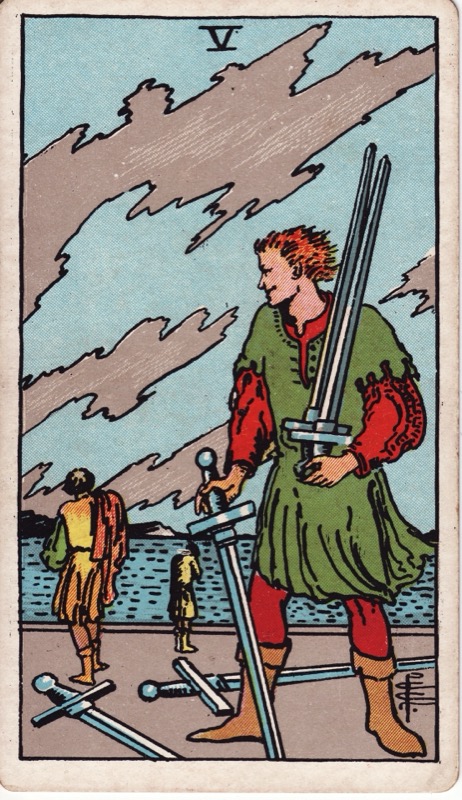
The Five of Swords shows the aftermath of a fight rather than the fight itself. In the Rider-Waite-Smith deck, a man stands in the foreground holding three swords, with two more lying at his feet. He has clearly won, since he now holds every weapon on the field, and the smirk on his face as he glances over his shoulder makes it plain he is pleased with himself.
The rest of the image undercuts that victory. Two figures walk away from him toward a gray, choppy sea. One has his head in his hands, either weeping or simply defeated. Neither looks back. The winner is left holding five swords he cannot possibly carry or use alone, on a field that everyone else has abandoned. Overhead, the clouds are jagged and wind-torn, the visual signature Pamela Colman Smith used throughout the suit for mental turbulence that hasn’t settled yet.
The number five brings instability to every suit, and in Swords, the suit of the mind and of conflict, that instability becomes open hostility. The card’s traditional Golden Dawn title is the Lord of Defeat, and the title deliberately refuses to say whose defeat it means. Depending on where you stand in the scene, you are the smirking victor, one of the figures walking away, or both at different moments of the same dispute.
Five of Swords Upright Meaning
The Five of Swords upright means conflict, tension, and a victory that isn’t worth its price. Someone in the situation is playing to win at all costs, and even if they succeed, the damage to trust and goodwill will outlast whatever they gained.
The first question this card raises is which figure in the scene is you. If you are the one collecting swords, the card is a warning. You may be right on the facts, and you may win the argument, and the people on the other side of it will still remember how you treated them long after they’ve forgotten what the dispute was about. Being correct and being wise are different achievements, and this card marks the gap between them.
If you are one of the figures walking away, the card validates the retreat. Not every battle deserves your participation, and withdrawing from a fight you cannot win, or one that would cost too much to win, is a legitimate strategy rather than a failure. The people leaving the field in the image are the only ones in the scene who get to go home.
The card also describes environments rather than single arguments. A workplace where colleagues undermine each other, a family where every gathering turns into a scorekeeping session, or a friend group with a running feud all carry Five of Swords energy. In those settings the practical advice is to stop expecting the environment to change and start deciding how much of yourself you’re willing to spend inside it.
One more layer is worth naming. The Swords suit is mental, so the conflict here is often fought with words: sarcasm, gossip, legal threats, the devastating comeback you rehearsed in the shower. The card takes those weapons seriously. A cutting remark can end a friendship as thoroughly as any dramatic betrayal, and the man in the image did all his damage without a single sword being described as bloody.
Five of Swords Upright: Love & Relationships
In love, the Five of Swords upright means conflict has entered the relationship and someone is treating it as a contest to win rather than a problem to solve. Arguments in this energy produce a victor and a loser, and both people end up worse off.
If you’re single, this card often points to games in the dating pool: someone keeping score, playing hot and cold as a power move, or pursuing you mainly to beat a rival. It can also describe the residue of a past relationship, where an ugly breakup left you approaching new people with your guard up and your comebacks pre-loaded. Someone who makes you feel like you’re constantly losing a competition you never entered is showing you the card in person, and you’re allowed to be the figure who walks off the field.
If you’re in a relationship, the Five of Swords describes the fight where winning replaced understanding. One or both of you has started collecting evidence, bringing up old offenses as ammunition, or going for the remark that hurts most rather than the one that’s true. The card’s warning is specific: you can win every argument and still lose the relationship, because each victory teaches your partner that being close to you is unsafe. The repair starts when one person declines to score the next available point.
Five of Swords Upright: Career & Work
In career readings, the Five of Swords upright means workplace conflict, office politics, or a professional environment where ambition has turned predatory. Someone may be taking credit for your work, undermining you to management, or competing with you by means you wouldn’t use yourself.
The card asks you to assess the battlefield honestly before you engage. Some workplace fights are worth having, especially where your reputation or your pay is on the line, and those are worth fighting cleanly and on the record. Many others are pure ego, and entering them costs you focus, allies, and the moral high ground even when you win. A useful test is to ask what you actually hold if you come out on top. The man in the image holds five swords and stands alone, which is a fair portrait of the colleague who won every turf war and now can’t get anyone to collaborate with him.
If the environment itself is the problem, the card can be an early signal to plan an exit. A toxic team rarely reforms because one person argues well.
Five of Swords Upright: Money & Finances
For money, the Five of Swords upright warns of financial conflict and of gains that come at someone’s expense in a way that will circle back on you. Disputes over shared money sit at the center of its range: contested inheritances, messy divorce settlements, unpaid loans between friends, or business partners fighting over a split.
The card’s advice is to weigh the full cost of the fight, including the parts that don’t appear on a balance sheet. Litigation that consumes two years and a friendship to recover a modest sum is a Five of Swords outcome even when you technically win. It can also flag a deal where the other party is playing dirty, so read contracts closely and get agreements in writing before money moves. Where you’re the one tempted to cut a corner, the card is blunt: the reputation you spend on a fast gain doesn’t come back at the same price.
Five of Swords as Feelings
If you’re asking how someone feels about you, the Five of Swords means they are approaching the connection as a contest. They may feel a need to have the upper hand, to win exchanges with you, or to protect themselves so thoroughly that every interaction carries an edge. In some cases the card shows outright resentment left over from a fight the two of you never fully resolved.
There is a softer possibility worth checking. Some people carry this card’s energy as pure defensiveness, hostility worn as armor by someone who has lost badly before. The behavior looks identical from the outside, and the practical guidance is the same either way: notice whether being around this person feels like a negotiation, because feelings that only express themselves through conflict are exhausting to receive regardless of what sits underneath them.
Five of Swords as Advice / Action
As advice, the Five of Swords tells you to pick your battles and to walk away from the ones that can’t be won at an acceptable cost. Before your next move in the conflict, name what victory would actually get you, then name what it would cost in trust, energy, and relationships. If the second list is longer, leave the field with the two figures in the background.
If the battle genuinely must be fought, the card advises fighting it cleanly, in writing where possible, and without the smirk. The version of you that wins graciously keeps allies for the next dispute. It also cautions against dealing with anyone currently in win-at-all-costs mode as though they were negotiating in good faith, because they aren’t, and your reasonableness reads to them as an opening.
Five of Swords Reversed Meaning
The Five of Swords reversed means a conflict is ending, through reconciliation, surrender, or a decision to stop fighting and cut your losses. It can also mean an old grudge resurfacing or a resentment you’ve carried too long, so the card asks which stage of the ending you’re in.
The most common reading is relief. A dispute that has been running for weeks or years starts to wind down: someone apologizes first, a settlement gets signed, or both sides simply run out of appetite for the fight. The reversal often appears at the exact moment when continuing would be easy and stopping takes actual courage, because ending a conflict usually requires someone to absorb a little pride damage and go first.
The second reading is unfinished business. Reversed, the card can show a fight that officially ended while the resentment survived intact. The apology happened, the papers were signed, and one party still rehearses the argument in the car. If that’s you, the card points out that the person you’re still fighting stopped showing up to the battle a long time ago, and the swords you’re holding are only weighing down your own hands.
A third, less frequent reading is total defeat, the moment of accepting that a battle is lost. That acceptance stings, and it is also the only exit from a fight that was consuming you. In the card’s imagery, reversal lets the swords finally fall to the ground.
Which reading applies usually depends on your honest answer to one question: has the fighting actually stopped, or has it just moved inside your head?
Five of Swords Reversed: Love
In love, the Five of Swords reversed means a conflict in the relationship is resolving, or that it’s time to release a resentment that has outlived the fight that caused it. Couples often draw this card right after the worst argument they’ve had, at the point where both people are deciding whether to repair or to keep score.
If you’re single, the reversal frequently marks recovery from a combative relationship or a bitter breakup. The guard you built during that period made sense at the time and is now filtering out people who never did anything to earn it. Forgiving an ex, quietly and without a reunion, is a common practical expression of this card, and it tends to change how dating feels within weeks.
If you’re in a relationship, the reversed Five of Swords favors the repair conversation. One of you going first with a genuine apology, or a mutual agreement to retire a recurring argument neither of you can win, fits the card exactly. Watch for the counterfeit version, where the fight ends on the surface and continues through silence and small retaliations. A truce that both people honor beats a victory either one could have taken.
Five of Swords Reversed: Career & Money
For career and money, the Five of Swords reversed means a workplace conflict or financial dispute is winding down, and the smart move is to let it. A feud with a colleague loses steam, a legal matter reaches settlement talks, or you finally stop pouring energy into a fight over a sum that no longer justifies it.
Cutting losses is the card’s central financial instruction. The investment that has been underwater for a year, the venture you keep funding out of stubbornness, and the dispute where legal fees are outpacing the claim all fall under it. Money already spent is gone whether or not you keep fighting, and the reversal gives you permission to stop.
At work, the reversal can also mark your exit from a toxic environment, sometimes literally through a resignation. Leaving a battlefield is not the same as losing on it, and the version of you that starts fresh elsewhere carries no swords at all.
Five of Swords Reversed as Feelings
If you’re asking how someone feels about you, the Five of Swords reversed means they regret a conflict between you and are looking for a way back. Pride is usually the obstacle, so the desire to reconcile may show up sideways, as small gestures, renewed contact about trivial things, or an apology that arrives clumsy and incomplete. Take the intent seriously even when the delivery is awkward. Less often, the reversal shows someone still nursing the grudge and unable to put it down, in which case their feelings are stuck at the moment the fight ended. Their recent behavior toward you will tell you quickly which version you’re dealing with.
Five of Swords: Yes or No?
The Five of Swords is a no. In yes-or-no readings it warns that the path you’re asking about leads through conflict, and that even a technical win would arrive with costs you’d regret. Questions about confrontations, disputes, and competitive gambles get an especially firm no from this card.
Reversed, the answer softens to a qualified no that comes with an instruction: the outcome you want becomes possible only after the current conflict is genuinely resolved. You can ask a yes or no question in a free reading to see which orientation the card takes for your situation.
Five of Swords Card Combinations
The cards around the Five of Swords tell you what the conflict is about and how it resolves. These pairings appear often enough to be worth knowing:
- Five of Swords + Two of Cups: a fight inside a close bond. Winning the argument threatens the partnership itself, so repair matters more than being right.
- Five of Swords + Justice: a dispute headed for formal resolution, often legal or contractual. Fight cleanly and keep records, because the outcome will follow the evidence.
- Five of Swords + The Devil: manipulation and power games rather than honest disagreement. Someone is playing dirty, and disengaging beats out-scheming them.
- Five of Swords + Ten of Wands: a victory that becomes a burden. You won the fight and inherited everything it was about, and now you carry it alone.
- Five of Swords + Six of Swords: leaving the battlefield for calmer water. The conflict ends through departure, and the recovery begins once you’re moving.
Five of Swords Meaning: Quick Reference
Use this table as the short version of the card during a reading.
| Context | Five of Swords means |
|---|---|
| Upright | Conflict, hollow victory, winning at all costs, defeat |
| Reversed | Reconciliation, releasing resentment, cutting losses |
| Love | Arguments where winning replaced understanding; repair or walk away |
| Career | Office politics and turf wars; weigh what victory actually gets you |
| Yes or No | No |
After the battlefield comes the boat. Continue to the Six of Swords, where the figures who walked away begin their recovery, or browse all Suit of Swords card meanings.