Death Tarot Card Meaning
Death means endings, transformation, and a major transition that clears space for something new. It is card 13 of the Major Arcana, and in practice it almost never predicts a physical death. Upright, it marks the definite close of a chapter, a relationship, a job, a home, or an identity that has run its course. Reversed, it points to a change you are resisting, and to the stagnation that builds up while you resist it.
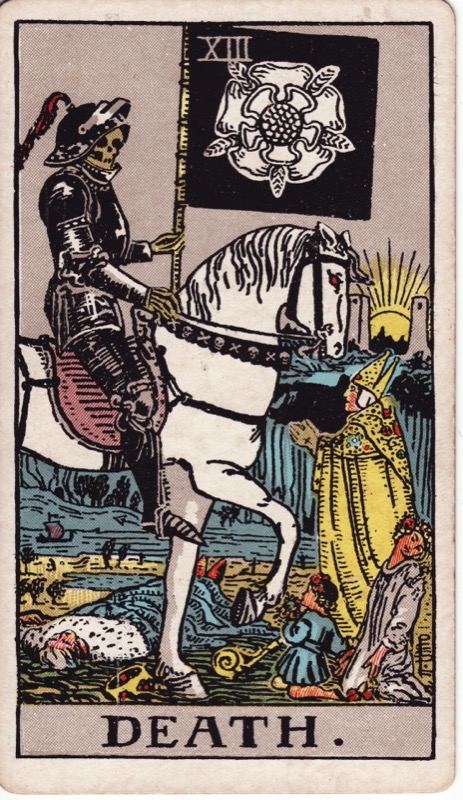
Death Keywords
Death’s core keywords are endings and transformation when upright, and resistance to change and stagnation when reversed. These eight pairs cover most of what the card means in an actual reading.
| Upright | Reversed |
|---|---|
| Endings | Resistance to change |
| Transformation | Stagnation |
| Transition | Fear of endings |
| Letting go | Holding on too long |
| Necessary change | Delayed ending |
| Release | Inability to move on |
| Closure | Repeating old cycles |
| A new chapter ahead | Slow, partial decay |
Death Description
Death shows a skeleton in black armor riding a white horse across a field where the old order has already fallen. In the Rider-Waite-Smith deck the skeleton carries no weapon. Instead it holds a black banner bearing a white five-petaled rose, a symbol of life and beauty that persists through every ending. The armor says the process cannot be stopped or negotiated with; the rose says something good survives it.
Four figures meet the rider, and their reactions map the human responses to unavoidable change. A king lies dead on the ground, his crown tipped off, because status offers no exemption. A bishop stands and pleads, hands raised, bargaining with a process that does not bargain. A young woman kneels and turns her face away, unable to look. Only the small child faces the horse directly and offers flowers, greeting the change with open curiosity because she has no past to defend.
In the background a river runs toward the horizon, and a boat crosses it, an echo of older myths about ferrying souls to the next world. Between two distant towers the sun sits low on the horizon. Most readers see it rising rather than setting, which fits the card’s real subject. The number 13 follows 12, The Hanged Man, whose suspension and surrender make this ending possible, and precedes 14, Temperance, where the new life gets integrated.
Death Upright Meaning
Death upright means a chapter of your life is ending, and the ending is necessary. It stands for transformation, transition, and letting go of what has already stopped working. Fighting the change will only prolong it; accepting it starts the renewal.
The card usually confirms something you already know. By the time Death appears in a reading, the relationship, the job, or the version of yourself in question has typically been finished for a while, and the only live decision is how long you spend pretending otherwise. The rider on the card moves at a steady walk. Nothing about the image is sudden, and that matches how these endings tend to arrive: gradually, visibly, and with plenty of warning that went unread.
What makes Death different from a simple loss card is the second half of its meaning. Every ending it describes creates room. People who look back on a Death period a year later usually describe it as the point where their current life became possible, even when the ending itself was painful. The card asks you to hold both facts at once: the grief is real, and so is the opening behind it.
Death also speaks to identity. Some of the endings it marks are internal, such as outgrowing a belief about yourself, retiring a role you have played in your family, or letting go of an ambition that belonged to a younger version of you. These transitions rarely get a ceremony, and they can be harder than external ones precisely because nobody else sees them happening.
The practical instruction is to cooperate with the ending rather than manage it into a slower shape. That means having the final conversation in full and signing the papers instead of leaving both at ninety percent. Half-endings cost more than full ones, because they keep the old chapter on life support while blocking the new one from starting. Whatever is ending was going to end regardless of how you voted, and your energy is better spent on what comes after.
Death Upright: Love & Relationships
In love, Death upright means a relationship is transforming or ending, and either way the current form of it is finished. The card asks you to let the old version go so an honest new one can exist.
If you’re single, Death often points at the baggage stage rather than the meeting stage. It can mark the moment you finally stop measuring new people against an ex, or the moment an old attachment genuinely releases its grip. It also asks whether a pattern needs to die before a partner can arrive, such as chasing unavailable people or abandoning connections at the first sign of depth. Closing that loop matters more right now than any individual date.
If you’re in a relationship, the card has two readings and the surrounding cards decide between them. The harder reading is that the relationship has run its course and both of you know it. The more common reading is that a phase of the relationship is dying so a better one can form: the honeymoon giving way to something realistic, or an old dynamic, like one partner always managing the other, finally being dismantled. Couples who survive a Death transit usually say the relationship afterward felt like a second, different relationship with the same person.
Death Upright: Career & Work
In career readings, Death upright means a professional chapter is closing, whether through a layoff, a resignation you have been postponing, a company restructuring, or the quiet end of your interest in a field. The card treats the closure as overdue rather than tragic.
If you have been forcing yourself through a job that stopped fitting years ago, Death names the situation plainly: the career you are protecting is already over in every way except the paperwork. The useful question shifts from whether to leave to how to leave well, with savings in place and a direction sketched out.
When the ending is imposed from outside, such as a role being eliminated, the card reframes it as a release from a path you would not have left voluntarily. A surprising number of career changes people describe as the best thing that happened to them began as a Death event they did not choose.
Death Upright: Money & Finances
For money, Death upright means an old financial structure is ending and needs to be replaced rather than patched. That can mean an income source drying up, a debt finally being cleared, closing a business, or the end of a spending pattern that has quietly drained you for years.
The card favors clean breaks over gradual tapering. Selling an asset that has sat underwater for two years beats budgeting around it indefinitely, and one afternoon spent canceling everything beats a year of meaning to. If a source of income is disappearing, treat the loss as confirmed and start building its replacement now instead of waiting to see whether it somehow recovers. Rebuild the budget from scratch around the life you are moving into, since the old one no longer describes your actual situation.
Death as Feelings
If you’re asking how someone feels about you, Death means their feelings are going through a fundamental change, or they associate you with a major turning point in their life. The old way they felt is gone, and what replaces it has not fully formed.
That can run in either direction. Sometimes it means an intense old attachment is dying off and they are quietly detaching. Just as often it means meeting you ended a previous chapter for them, such as finally getting over an ex or letting go of how they thought their life would look, and the feeling attached to you is heavy with that significance. Either way, expect depth rather than lightness, and give the transformation time to finish before you demand a label for it.
Death as Advice / Action
As advice, Death tells you to end it. Whatever you brought to the reading, the card’s counsel is to stop resuscitating something that has already died and to make the ending complete rather than partial. A finished chapter treated as finished loses most of its power to hurt you.
The card adds one refinement: cut cleanly, then grieve properly. Skipping the grief is how endings turn into hauntings, so give the loss its real weight for a defined period. What Death advises against is the middle state, where the thing is over but you still check on it, reopen it, and negotiate with it. The child on the card models the target attitude, facing the change directly and looking for what it brings.
Death Reversed Meaning
Death reversed means resistance to change, stagnation, and an ending you refuse to accept. The transformation the upright card describes is still due; reversed, it is being blocked, and the blockage is producing decay instead of stability.
The most common form is simple refusal. A relationship or a job ended in every meaningful sense months or years ago, and you are still showing up to it, held there by fear, sunk costs, or loyalty to a version of events that no longer exists. The reversed card points out what this costs. Change deferred does not politely wait; it compounds. The job you should have left in the spring is harder to leave by winter, because the confidence and energy you would use to leave are exactly what staying erodes.
A second form is incomplete mourning. Here the ending did happen, but you never processed it, so it stays active in the background: the ex whose messages you still reread, the career setback from years ago that still writes your inner monologue. Reversed Death describes a past that has been kept artificially alive, and it suggests the unfinished grief is what keeps pulling new beginnings backward.
There is also a gentler reading worth checking against your situation. Sometimes the reversed card marks the very last stage of resistance, the point just before surrender, when you have privately admitted the truth and are gathering the nerve to act on it. If that describes you, the card is close to good news, since the hardest part, the admission, is already done. In every version, the message converges on the same point: the door has been open for a long time, and the discomfort you feel is the cost of standing in the doorway.
Death Reversed: Love
In love, Death reversed means a relationship or attachment that should have ended is being kept alive, or grief for a past relationship is blocking a future one. The change the connection needs is being refused by at least one person involved.
If you’re single, the card usually points backward. An ex still occupies the space a new partner would need, whether through actual contact, social media surveillance, or a running internal comparison that no new person can win. Reversed Death says the previous relationship is not finished inside you, and finishing it there is the real work. Dating on top of unfinished grief tends to produce relationships that exist mainly to distract from it.
If you’re in a relationship, the card describes a partnership surviving on inertia. Both of you may sense that the current form is over, and both keep performing it because the ending feels too expensive to face. Sometimes what needs to die is a dynamic rather than the relationship itself, but reversed, even that smaller death is being dodged, and the avoided conversation sits in the room during every other conversation. Whichever it is, delay is the one option the card rules out. To get a direct answer on where things stand, try a free yes or no reading.
Death Reversed: Career & Money
For career and money, Death reversed warns that you are clinging to a dead professional or financial situation and paying for the delay. The job that ended in spirit long ago, the business model the market has moved past, and the investment you hold only to avoid admitting the loss all belong to this card.
Sunk cost is the engine of most of it. Years already invested feel like a reason to stay, when they are only a measure of what staying has cost so far. The card’s counsel is to price the situation as it stands today, with no credit for history, and act on that number.
Financially, reversed Death also covers zombie obligations, such as debts left unaddressed and accounts left open out of avoidance. Facing the full balance in one sitting is unpleasant for an afternoon; refusing to look at it is unpleasant indefinitely.
Death Reversed as Feelings
If you’re asking how someone feels about you, Death reversed means they are stuck between feelings, unable to release an old attachment or to let a change in the connection complete. Often it describes someone still emotionally tied to a past relationship, offering you the space left over. It can also describe someone whose feelings for you have shifted and who has not admitted the shift, even privately, so what reaches you is a lag: yesterday’s warmth on a delay, going through motions that no longer match the inner state. Watch for consistency between their words and their actions over several weeks, because with this card the actions carry the truth first.
Death: Yes or No?
Death is a no for most questions, especially ones about whether a situation will continue, recover, or return to how it was. The card answers by pointing at an ending, so questions that need continuation get a clear negative.
The important exception is questions about change itself. If you are asking whether to leave, whether to end something, or whether a transformation you are considering is right, Death functions as a strong yes, since ending and transformation are exactly what it endorses. Reversed, the answer stays no and adds a warning that delay is making the situation worse.
Death Card Combinations
The cards around Death tell you what kind of ending it is and what follows it. These pairings are worth learning first:
- Death + Temperance: the healthiest version of the card. An ending followed by patient rebuilding, with the change absorbed gradually instead of violently. These are consecutive cards, and together they describe a transition handled well.
- Death + The Star: hope and healing directly after a loss. Whatever ends here ends for a reason you will eventually be grateful for, and recovery comes faster than expected.
- Death + Wheel of Fortune: a fated turning point. The ending is driven by forces outside your control, and adaptation will serve you far better than resistance.
- Death + Ten of Swords: a total, painful, and final ending, often a betrayal or collapse. The consolation is completeness, since nothing about the situation can get worse or drag on.
- Death + Ace of Cups: emotional rebirth. An old love or an old way of feeling ends, and a genuinely new one begins, frequently in the same season.
Death Meaning: Quick Reference
Use this table as the short version of the card during a reading.
| Context | Death means |
|---|---|
| Upright | Endings, transformation, transition, necessary change |
| Reversed | Resistance to change, stagnation, an ending refused |
| Love | The current form of the relationship is finished; let it transform |
| Career | A professional chapter is closing; leave cleanly and rebuild |
| Yes or No | No (yes only when the question is about change itself) |
Death follows the surrender of The Hanged Man and hands its ending to the next card to integrate. Continue to Temperance.