Eight of Swords Tarot Card Meaning
The Eight of Swords means restriction, self-imposed limitation, and feeling trapped by circumstances that are looser than they appear. It is card 8 of the Suit of Swords, and it usually arrives when your thinking, rather than your situation, is what has you stuck. Upright, it says the exit exists and your own beliefs are hiding it. Reversed, it marks the moment the blindfold comes off, or a warning that you are settling deeper into the role of prisoner.
Eight of Swords Keywords
The Eight of Swords’ core keywords are restriction and self-imposed limits when upright, and release and new perspective when reversed. These pairs cover most of the ways the card shows up in practice.
| Upright | Reversed |
|---|---|
| Restriction | Release |
| Feeling trapped | New perspective |
| Self-imposed limits | Self-acceptance |
| Victim mindset | Taking back control |
| Powerlessness | Facing fears |
| Anxiety and overthinking | Open eyes |
| Isolation | Freedom after struggle |
| Waiting for rescue | Deepening paralysis |
Eight of Swords Description
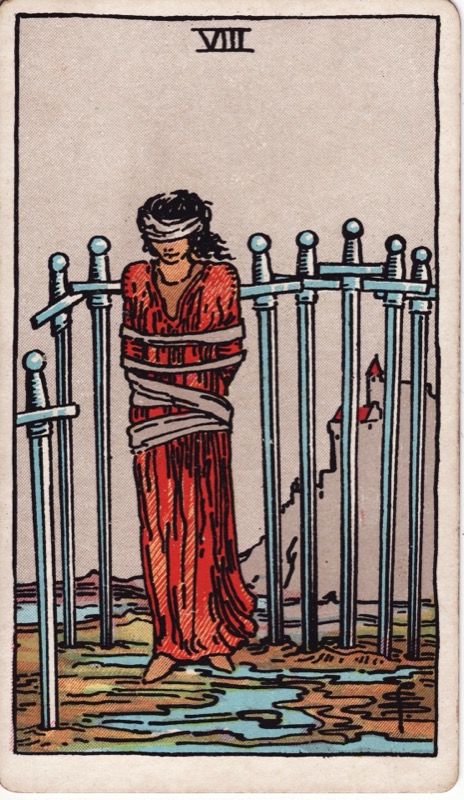
The Eight of Swords shows a woman standing alone in a barren landscape, bound and blindfolded, with eight swords planted in the ground around her. In the Rider-Waite-Smith image the swords form a loose fence rather than a cage. There is a clear gap in front of her, and nothing behind her blocks a retreat. The trap only works because she cannot see it.
Look closer and the bindings tell the same story. The cloth around her arms is wrapped, without any visible knot, and her legs are completely free. She could walk out of the swords at any moment, and she could probably shrug the restraints off with some effort. What actually holds her in place is the blindfold, which stands for the beliefs, fears, and assumptions she has accepted about her situation.
The ground beneath her is wet and marshy, shallow puddles reflecting a gray sky, which readers take as emotional discomfort seeping into a problem that is supposed to be purely mental. In the distance, a castle sits on a cliff. Some read it as the safety she left behind; others read it as an authority she believes is watching and judging her. Either way, help is not coming from that direction. The Suit of Swords deals in thought and perception, and this card is its clearest picture of a mind imprisoning its owner.
Eight of Swords Upright Meaning
The Eight of Swords upright means you feel trapped, but the restriction is largely self-imposed and an exit exists. It stands for limiting beliefs, anxiety, and a sense of powerlessness that dissolves once you question the assumptions holding it up.
This card almost never appears when someone is genuinely, physically cornered. It appears when a person has real options and has talked themselves out of all of them. The reasoning usually sounds sensible from the inside: I can’t leave this job because nobody else would hire me, I can’t raise this issue because it would destroy the relationship, I can’t start over because it’s too late. Each of those statements feels like a fact and functions like a wall. The Eight of Swords asks you to test the wall, because in this card’s territory the walls are made of untested assumptions.
Anxiety is the card’s engine. Eights in tarot describe momentum and repetition, and in the Suit of Swords that repetition becomes a thought loop, the same worry circling for the fortieth time and producing the same paralysis. Overthinking feels like problem-solving while you are doing it, which is exactly why it is so hard to stop. The card draws a hard line between the two: problem-solving ends in an action, and a loop ends where it started.
There is also a passivity to the figure worth naming. She is waiting, and part of her is waiting for someone else to arrive and untie her. The Eight of Swords is honest about how comfortable that waiting can become. Being stuck comes with a strange safety, because a prisoner is never blamed for failing to act. The card’s message is that no rescuer is scheduled, and that the first small independent movement, a phone call, an application, a single honest sentence spoken aloud, is what starts loosening the wraps.
One check keeps this reading honest. A minority of situations involve real external constraint, such as financial dependence or a controlling person. If that describes yours, the card still applies, but its target shifts from “the trap is imaginary” to “your view of the exits is narrower than the reality.” Fresh eyes, often another person’s, will find doors you have stopped seeing.
Eight of Swords Upright: Love & Relationships
In love, the Eight of Swords upright means you feel stuck in your romantic situation, and the belief that you have no options is doing more damage than the situation itself.
If you’re single, this card usually points to the stories you tell about your own prospects. Common versions include being too old, too damaged from the last relationship, or convinced that everyone worth meeting is taken. Those beliefs act like the blindfold in the image: they filter out real opportunities before you consciously register them, so the world appears to confirm the story. The card also flags avoidance dressed up as standards, where every potential person is disqualified early because rejection can’t reach someone who never tries. Loosening one assumption, and acting on it once, is how movement begins.
If you’re in a relationship, the Eight of Swords describes feeling trapped with a partner while believing you cannot say so. Often the unsayable thing has been rehearsed silently for months. The card’s consistent finding is that the conversation you are avoiding is smaller than the version in your head, and that your partner may have no idea anything is wrong. It can also appear when someone stays in a genuinely unhappy relationship out of fear of being alone, treating loneliness as certain and staying as safe. Neither assumption survives contact with reality as well as it survives in the dark.
Eight of Swords Upright: Career & Work
In career readings, the Eight of Swords upright means you feel trapped in your job or career path, and the constraints keeping you there are mostly beliefs about what you can’t do.
The classic case is the person who has wanted to leave for a year but “can’t,” where can’t turns out to mean hasn’t updated the resume, hasn’t had one exploratory conversation, and hasn’t checked what the market actually pays. The trap is maintained by never testing it. A weaker version shows up inside a role: staying silent in meetings, declining stretch work, and assuming a promotion is impossible without ever asking what it would require.
Office politics can also put this card on the table, particularly the feeling of being boxed in by a difficult manager. Even there, the card insists your option list is longer than it feels. Internal transfers, documented conversations, and outside offers all exist, and each becomes visible only when you look at it directly. Start by writing down every constraint you believe you are under, then mark which ones you have actually verified. The unverified ones are the swords.
Eight of Swords Upright: Money & Finances
For money, the Eight of Swords upright means you feel financially trapped, and avoidance is a bigger factor than the numbers. People who pull this card frequently have not looked at the full picture in months, because not knowing feels safer than confirming the fear.
The remedy is unglamorous: open the accounts, add up the debts, and get the real figure in front of you. Almost everyone who does this finds the reality more workable than the dread suggested, and even when the number is bad, a known number can be negotiated, restructured, and paid down. A vague one can only be feared. The card can also mark a belief-level trap, such as being certain you are simply bad with money. Treat that as one more untested assumption rather than a fixed trait.
Eight of Swords as Feelings
If you’re asking how someone feels about you, the Eight of Swords means they feel stuck and unable to act on their feelings. Interest is usually present under the paralysis. Fear is running the show: fear of rejection, fear of repeating an old wound, or fear of disturbing a complicated situation they are already in.
Expect the behavior to match the card, which is to say very little behavior at all. This person circles, hesitates, and drafts messages they never send, and from the outside that reads as indifference even when it isn’t. The card can also mean they feel trapped by the connection itself, wanting out of an entanglement and not knowing how to say it. In both readings, the useful takeaway is the same: you cannot untie someone from the outside, and their inaction is information about their capacity right now, whatever their feelings underneath it.
Eight of Swords as Advice / Action
As advice, the Eight of Swords tells you to question the constraint before you obey it. Take the belief that most limits you, phrase it as a claim, and go verify it this week. Ask the question, check the listing, run the numbers, or say the sentence, and let reality answer instead of the loop in your head.
The card also prescribes borrowed eyes. A blindfolded person’s best asset is someone who can see, so describe your trap to a friend, a therapist, or a mentor and let them list the exits you have edited out. Expect their list to be longer than yours, and notice your urge to explain why each item is impossible. That urge is the wrap around your arms. You do not need to solve everything at once; you need one verified fact and one small step through the gap in the swords.
Eight of Swords Reversed Meaning
The Eight of Swords reversed means release from self-imposed restriction, a new perspective, and taking back control. The blindfold is coming off, limiting beliefs are losing their grip, and options that were always present are becoming visible. Less often, it warns of paralysis deepening instead.
The primary reading is liberation in progress. Reversed, this card frequently lands right after a shift you can feel: you finally said the thing, quit the thing, or simply woke up one morning and noticed the story you had been living inside. What follows the blindfold’s removal is rarely comfortable, because seeing clearly means seeing how long you stayed and how loose the bindings were. The card asks you to spend that energy on walking out rather than on self-blame. Everyone who has been in this position kept themselves there past the point they needed to, and the exit matters more than the audit.
The secondary reading points the other way. A reversal can intensify a card’s shadow, and here that looks like surrendering to stuckness: the victim story hardening into an identity, isolation increasing, and every offered exit rejected with a prepared reason. The tell is your reaction to help. Someone in the releasing pattern hears a suggestion and feels a spark of possibility; someone in the deepening pattern hears the same suggestion and immediately argues for the trap.
Context in the spread usually settles which reading applies, and so does an honest look at the past month. If anything has loosened at all, read the card as release and push in that direction. If everything has tightened, read it as the warning, and treat getting one outside perspective as urgent rather than optional.
Eight of Swords Reversed: Love
In love, the Eight of Swords reversed means release from a restrictive romantic pattern, whether that is leaving a confining relationship or finally dropping a belief that kept love out.
If you’re single, this card often marks the end of a long defensive crouch. The conviction that you would only get hurt again, or that something about you disqualifies you, is losing its authority, and dating starts to feel like an open field instead of a minefield. Old attractions to unavailable people can also fall away here, since that pattern is its own set of swords. Expect the new openness to feel exposed at first. That is what a face without a blindfold feels like.
If you’re in a relationship, the reversed card points to freed communication. A silence that lasted months breaks, the avoided conversation finally happens, and the relationship either improves because of it or reveals itself clearly enough to leave. Both outcomes count as release. This card also appears when someone has recently ended a controlling or suffocating relationship, in which case it is confirmation: the trapped feeling was real, the exit was right, and the disorientation you feel now is recovery rather than a mistake.
Eight of Swords Reversed: Career & Money
For career and money, the Eight of Swords reversed means the professional or financial trap is opening, usually because you have started testing the assumptions that held it shut. The resume goes out, the raise gets requested, the side income becomes real, and the “impossible” options turn out to have been merely unattempted.
This is a strong card for anyone mid-escape from a draining job. It says the constraint was never as absolute as it felt, and it backs continued movement over renewed deliberation. If you have just discovered how much you were underpaid or how employable you actually are, that discovery is this card in action.
Financially, the reversal favors facing numbers you previously avoided. Debts get consolidated, budgets get written, and the relief of knowing replaces the low hum of dread. Watch for one residual risk: swinging from paralysis into rash moves to make up for lost time. You have room to be deliberate now that you can see.
Eight of Swords Reversed as Feelings
If you’re asking how someone feels about you, the Eight of Swords reversed means they are working free of whatever kept them from acting on their feelings. The fear or entanglement that held them in place is loosening, and their behavior should start showing it in small concrete ways: more initiative, more directness, fewer disappearances. This is often the card of someone finally ready after a long stretch of hesitation. Give the shift a few weeks to prove itself, since a person mid-release still moves unevenly. If nothing in their actions changes at all, the release is theoretical so far, and you should weigh what they do above what this card says they are trying to do.
Eight of Swords: Yes or No?
The Eight of Swords is a no. In yes-or-no readings it signals that the path you are asking about is blocked, and that the block is largely built from fear, avoidance, or incomplete information on your side. Acting right now means acting blindfolded.
The no is softer than the deck’s hardest refusals. Remove the blindfold first, meaning verify your assumptions and face what you have been avoiding, and the question often becomes askable again with a better answer waiting. Reversed, the card upgrades to a maybe leaning yes, since the restriction is already lifting. You can ask your own question with a free yes or no tarot reading.
Eight of Swords Card Combinations
The cards around the Eight of Swords tell you what the trap is made of and how it ends. These pairings come up often enough to be worth learning:
- Eight of Swords + The Devil: the self-imposed trap has hardened into real bondage, often an addiction, a toxic relationship, or a dependency you now benefit from admitting. The loosest chains in the deck meet the heaviest; take the combination seriously.
- Eight of Swords + Ace of Swords: breakthrough. One clear realization cuts every binding at once, and the truth that frees you is likely to arrive suddenly rather than gradually.
- Eight of Swords + Nine of Swords: the daytime trap becomes the 3 a.m. spiral. Anxiety is escalating, and the thought loop needs outside interruption, whether from a friend or a professional.
- Eight of Swords + The Moon: the blindfold plus fog. Your picture of the situation is doubly distorted, so gather facts before you conclude anything, because both cards specialize in fears that impersonate facts.
- Eight of Swords + Six of Swords: the exit taken. You leave the restrictive situation and move toward calmer water, and the passage is quiet rather than triumphant, which is normal.
Eight of Swords Meaning: Quick Reference
Use this table as the short version of the card during a reading.
| Context | The Eight of Swords means |
|---|---|
| Upright | Restriction, self-imposed limits, feeling trapped, anxiety |
| Reversed | Release, new perspective, taking back control, or deepening paralysis |
| Love | Feeling stuck or silenced; the avoided conversation is the exit |
| Career | Trapped in a role by untested assumptions; verify your constraints |
| Yes or No | No (a softer no; lifts once you face what you’ve avoided) |
The Eight of Swords sits between escape and despair in the suit’s story. The previous card is the Seven of Swords, the next is the Nine of Swords, or you can browse all Suit of Swords card meanings.