The Hierophant Tarot Card Meaning
The Hierophant means tradition, established institutions, spiritual guidance, and formal commitment. It is card 5 of the Major Arcana, and it appears when the conventional path is the one worth taking, or when a teacher, mentor, or established body of knowledge has something you need. Upright, it favors marriage, education, and doing things the recognized way. Reversed, it points to rebellion against convention, or to rules that have outlived their usefulness.
The Hierophant Keywords
The Hierophant’s core keywords are tradition and spiritual guidance when upright, and rebellion and restrictive convention when reversed. These pairs cover the card’s usual range in readings.
| Upright | Reversed |
|---|---|
| Tradition | Rebellion |
| Conventional path | Challenging the rules |
| Spiritual guidance | Restrictive dogma |
| Institutions | Unconventional choices |
| Mentorship | Rejecting authority |
| Formal commitment | Breaking with tradition |
| Shared beliefs | Personal belief over doctrine |
| Education | Rules that no longer fit |
The Hierophant Description
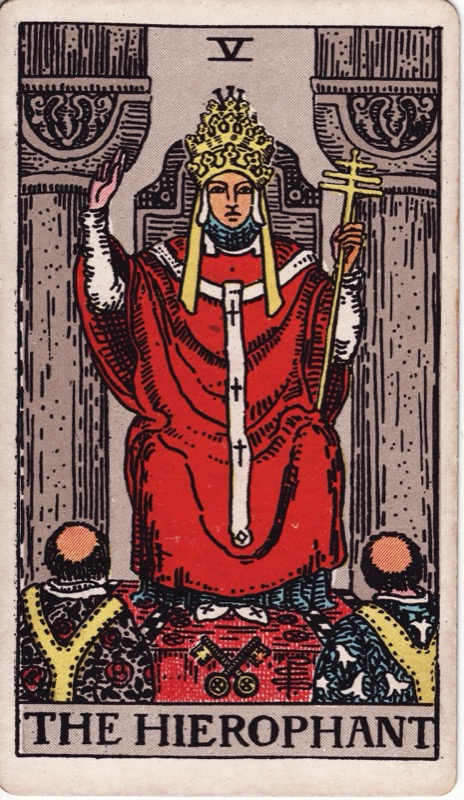
The Hierophant shows a religious figure seated on a throne between two grey stone pillars, facing forward and fully at home in his authority. In the Rider-Waite-Smith deck he wears the triple crown of a pope and a red robe over white, and everything about the composition is formal, symmetrical, and deliberate. Where The High Priestess guards hidden knowledge behind her veil, the Hierophant’s role is public. He translates spiritual law into teachings a community can actually follow.
His right hand is raised in a traditional gesture of blessing, two fingers pointing up and two down, linking heaven and earth. His left hand holds a triple-barred cross, a sceptre of religious office whose three bars are often read as the conscious, subconscious, and superconscious realms he mediates between. Two tonsured monks kneel at the foot of his throne. One wears a robe patterned with red roses for passion, the other with white lilies for purity, and their presence turns the card into a scene of instruction: knowledge passing from an institution to its initiates. At the Hierophant’s feet lie two crossed keys, gold and silver, representing the keys to the teachings he controls.
The card is numbered 5 and corresponds to Taurus, the fixed earth sign, which suits a figure whose whole job is continuity. The Hierophant preserves what a culture has already tested and hands it to the next generation intact.
The Hierophant Upright Meaning
The Hierophant upright means tradition, conventional structures, and guidance from an established source. It favors the proven path over the experimental one, and it often signals marriage, formal education, religious or spiritual practice, or a mentor entering your life at the right moment.
This card asks you to take seriously the value of things that were worked out before you arrived. Institutions get a bad reputation for stuffiness, and sometimes they earn it, but the Hierophant represents their real function: a body of accumulated knowledge that saves you from repeating every mistake personally. When it appears upright, the conventional route is conventional because it works. Applying through the official channel, getting the certification, having the ceremony, or joining the group that already does what you want to do will serve you better right now than improvising alone.
The Hierophant also carries a strong teaching current. It regularly shows up when you would benefit from structured learning rather than self-directed dabbling, or when a specific mentor figure is available to you and worth approaching. It can equally cast you as the teacher, the person in the room whose experience others need. Either way, the card describes knowledge moving through a recognized relationship, the way it moves from the robed figure to the two initiates in the image.
In spiritual questions, the upright Hierophant points toward shared practice. A community, a lineage, a congregation, or even a regular class gives belief a container, and this card says the container helps. Practicing alone is possible, and plenty of people do it well, but the Hierophant appears when belonging to something larger than yourself is the missing piece.
The card’s shadow, even upright, is conformity for its own sake. The Hierophant endorses tradition that still functions. It does not require you to switch off your judgment, and if a rule in your situation exists only because it always has, the reversed meaning below is worth reading too.
The Hierophant Upright: Love & Relationships
In love, The Hierophant upright means commitment in its formal, recognized sense. This is one of the deck’s clearest cards for marriage, engagement, and relationships built on shared values, and it favors partners who want the same conventional milestones.
If you’re single, the Hierophant suggests your next significant relationship will come through traditional channels and carry serious intent. Think introductions through family or community, meeting someone within a shared faith or shared institution, or a courtship that moves through recognizable stages instead of ambiguity. It also asks you to be honest about your values before you date. This card pairs people whose beliefs align, so knowing yours clearly is practical work, and someone whose life goals genuinely match your own will feel different from chemistry alone.
If you’re in a relationship, the card frequently precedes a step that makes things official: an engagement, a wedding, meeting the families, or a shared religious or cultural commitment. It also blesses the ordinary structures that keep long relationships steady, such as shared routines, agreed roles, and traditions the two of you keep together. If you have been wondering whether your partner sees a formal future with you, the Hierophant upright is an encouraging sign that they take the relationship as seriously as you do.
The Hierophant Upright: Career & Work
In career readings, The Hierophant upright points to established organizations, formal qualifications, and mentorship. It favors working within a structure, such as a large company, a licensed profession, an academic institution, or any field with a defined ladder to climb.
Practically, this card supports the credentialed route. If you have been debating whether the degree, certification, or accreditation is worth the effort, the Hierophant says it is, because in your situation the recognized qualification will open doors that talent alone will not. It also highlights mentorship as the fastest way forward. Somewhere in or near your workplace is a person who has already made the climb you are attempting, and asking to learn from them directly is the move this card recommends.
The Hierophant favors playing by the workplace’s existing rules for now. Learn how the institution actually operates before you try to change it. Reformers who understand the system outperform reformers who merely resent it.
The Hierophant Upright: Money & Finances
For money, The Hierophant upright means conventional, well-tested financial choices. It favors regulated products, established banks, employer pension schemes, index funds, and advice from a qualified professional over anything novel or loosely explained.
This is a poor moment for financial experiments. The exciting opportunity a friend mentioned, the unregulated platform, and the strategy you would struggle to explain to an advisor all sit outside this card’s blessing. If you need guidance, pay for the accredited kind. The Hierophant also supports financial traditions in the older sense, such as saving on a fixed schedule and following household money rules that previous generations of your family proved out. Boring, in this card’s territory, is a compliment.
The Hierophant as Feelings
If you’re asking how someone feels about you, The Hierophant means they feel seriously and traditionally about you. This person sees you as long-term material, the kind of partner they could bring home, marry, and build a conventional life with, and their intentions are more formal than flirtatious.
Their feelings likely run through the filter of their values. They are asking themselves whether you fit their beliefs, their family’s expectations, and their picture of a settled future, and the answer so far is favorable or the card would not appear upright. What you should not expect from this energy is wild spontaneity. Someone represented by the Hierophant expresses love through commitment, reliability, and doing things properly, so read steadiness from them as devotion rather than dullness.
The Hierophant as Advice / Action
As advice, The Hierophant tells you to take the conventional route and to seek guidance from someone qualified to give it. Follow the established procedure in your situation, whether that means the official application, the ceremony, the accredited course, or the standard treatment plan, and resist the urge to shortcut a process that exists for good reasons.
The card also advises finding a teacher. Whatever you are facing, someone has faced it before and codified what they learned, so locate that person, that book, or that institution and study before you act. If you are the experienced one in your situation, the advice inverts: your knowledge is needed, and passing it on formally, by teaching or mentoring, is the action the card names.
The Hierophant Reversed Meaning
The Hierophant reversed means rebellion against convention, restrictive rules, or a break with tradition. It appears when established structures no longer serve you, when you are challenging an institution or authority figure, or when conformity has been quietly costing you your own judgment.
A reversed card distorts the upright energy, and with the Hierophant the distortion runs in two directions worth telling apart.
The first direction is healthy rebellion. Here the card describes outgrowing a structure that once fit: leaving a religion you no longer believe in, questioning a family expectation about how your life should look, or working outside an industry’s standard career path because the standard path leads somewhere you do not want to go. In this version the reversal is a graduation. You have absorbed what the tradition had to teach and your own judgment is now the better guide, and the discomfort you feel is the ordinary cost of thinking for yourself in a group that would prefer you didn’t.
The second direction is dysfunction inside the structure itself. The reversed Hierophant can point to dogma enforced without understanding, an institution protecting itself instead of its members, a mentor or authority figure abusing trust, or rules applied rigidly where flexibility was needed. If an organization in your life demands loyalty while giving little back, or punishes reasonable questions, this card is naming that dynamic.
Distinguishing the two usually takes one honest look at your situation. When the rebellion is yours and considered, the card supports it. When the problem is a corrupt or calcified structure, the card tells you to stop expecting the structure to reform itself and to make your decisions accordingly. In both readings the underlying message holds steady: convention has stopped deserving your automatic obedience, and your own conscience currently outranks it.
The Hierophant Reversed: Love
In love, The Hierophant reversed means an unconventional relationship, or conflict between the relationship and the traditions surrounding it. It also covers commitment on paper that has gone hollow underneath.
If you’re single, this card often describes wanting a relationship that ignores the standard script. You may be uninterested in marriage, drawn to someone your family or community would not choose, or simply done dating the “suitable” type that never actually suits you. The reversed Hierophant supports building a partnership on your own terms, with one caution: make sure you are choosing differently because it fits you, and rejecting convention on purpose rather than out of reflex against an old wound.
If you’re in a relationship, the card can surface a values clash, frequently involving religion, family expectations, or disagreement about whether marriage matters. It can also describe a relationship that kept the form of commitment while losing the content, where the anniversary gets observed and the connection does not. External pressure is the other common reading, with parents, in-laws, or a community pushing the couple toward a mold that neither partner wants. The useful response in every version is the same conversation, held directly between the two of you, about which traditions you will keep, which you will drop, and whose approval you actually need.
The Hierophant Reversed: Career & Money
For career and money, The Hierophant reversed warns that the institutional path has stopped working, or that you have stopped working within it. It shows up for people chafing under rigid corporate culture, clashing with a manager over how things must be done, or realizing the credential they were told to get no longer guarantees what it used to.
If the reading is about a workplace, look honestly at whether the rules you are fighting are load-bearing or merely old. Some battles against process are worth winning, and some are a sign you belong somewhere less orthodox, such as a startup, freelance work, or a field without a fixed ladder. The reversed Hierophant frequently precedes exactly that kind of exit.
Financially, the card cuts both ways. It can endorse a departure from standard advice when the standard advice genuinely fails your circumstances, and it can also flag a guru, scheme, or advisor whose authority does not survive scrutiny. Check credentials before you follow anyone off the beaten path, including yourself.
The Hierophant Reversed as Feelings
If you’re asking how someone feels about you, The Hierophant reversed means they feel resistant to the conventional next step, even if their feelings for you are real. This person may care for you while dreading the framework around commitment, such as marriage talk, family involvement, or labels that come with expectations attached. Alternatively, they may see you as the person who frees them from a traditional life they never wanted, which is flattering and worth examining, since being someone’s rebellion is a role with an expiry date. Watch whether their resistance targets the institutions around love or the intimacy itself. The first can be worked with openly, and the second tends to surface again no matter how few rules you agree to.
The Hierophant: Yes or No?
The Hierophant is a yes, particularly for questions about marriage, commitment, education, and anything pursued through official or traditional channels. The card’s energy is stable and affirming, so long as you are willing to do things the recognized way.
The yes weakens if your question involves breaking rules, shortcuts, or unconventional routes, because those run against the card’s grain. Reversed, treat it as a no for the conventional version of your plan and a maybe for the unconventional one. For a direct answer on your own question, get a yes or no tarot reading.
The Hierophant Card Combinations
The cards around The Hierophant tell you which institution or tradition the reading is about. These pairings are worth knowing:
- The Hierophant + The Lovers: marriage. This is one of the strongest wedding signals in the deck, a love choice made formal and witnessed.
- The Hierophant + Four of Wands: a ceremony or milestone celebration, such as a wedding, graduation, or housewarming, with community gathered around it.
- The Hierophant + Two of Cups: a deep mutual bond moving toward official commitment, or a partnership blessed by both families.
- The Hierophant + The Devil: dogma turned controlling. An institution, belief system, or authority figure holding power through fear or obligation rather than genuine guidance.
- The Hierophant + Eight of Pentacles: apprenticeship and formal training. Skills built patiently under a qualified teacher, with credentials that pay off later.
The Hierophant Meaning: Quick Reference
Use this table as the short version of the card during a reading.
| Context | The Hierophant means |
|---|---|
| Upright | Tradition, spiritual guidance, institutions, formal commitment |
| Reversed | Rebellion, restrictive dogma, breaking with convention |
| Love | Marriage and serious commitment; shared values matter |
| Career | Established organizations, credentials, find a mentor |
| Yes or No | Yes |
The Hierophant teaches the rules of the community, and the card that follows tests them against personal choice. Continue to The Lovers, or go back to The Emperor.